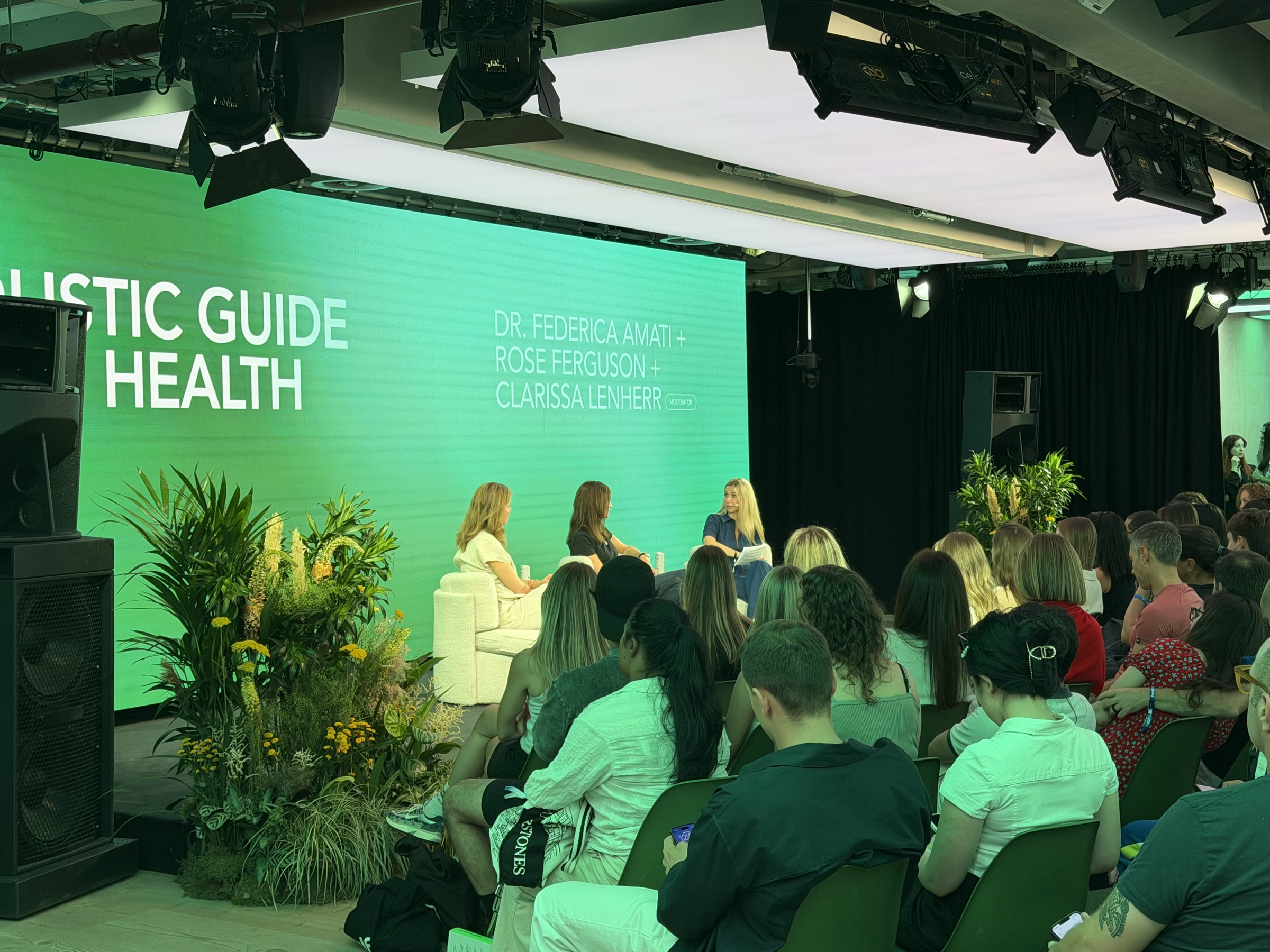

The first four parts of this series were about building the gut up — the drugs, the biology, the food, the habits. The last segment of the panel did the opposite: demolition. Asked to name the trends they wished would die, both experts lit up, and a single principle ran through every answer. Almost everything sold as gut "health" is really an attack on the gut. The science is on the side of support.
This is the through-line of the whole evening, and the reason the series is called Trust Your Gut: trusting it means knowing the difference between the things that nourish a complex ecosystem and the things that blast it. So, in the spirit of Dr Federica Amati and Rose Ferguson's myth-busting round, here is what they told a London audience to stop doing — and the honest, uncomfortable-for-everyone answer on supplements.
Put Down the Parasite Cleanse
Ferguson's heart sank at two words: "TikTok," and "cleanse." Parasite cleanses are everywhere on social media, and Amati had the number to explain why that should worry you rather than reassure you: only about 2% of health information on TikTok is evidence-based. Roughly one video in fifty contains advice worth following. As a filter for what to put in your body, that is close to useless.
2% of all health information on TikTok is accurate. Every 50 videos you watch, only one has any evidence behind it. Just remember that — don't look to TikTok for health.
The clinical reality, Ferguson explained, is that a genuinely pathogenic parasite is uncommon — most people convinced they "have a parasite" do not. And the cleanses themselves, built on powerful botanicals like wormwood, are indiscriminate: they don't just target the imagined invader, they tear through the whole microbiome, your carefully balanced ecosystem included. Amati's example was the perfect illustration. Blastocystis, a microbe routinely "nuked" out with antiparasitics, turns out in large datasets to be a marker of better health, not worse.
The better frame, both agreed, is crowding out rather than killing: build a robust, diverse microbiome (exactly the work of Part 3) and it naturally outcompetes the things you don't want, without the collateral damage of going in hard.
Colonics and Coffee Enemas
On colonic irrigation, Amati was as close to categorical as she got all night: ask any gastroenterologist, she said, and they will tell you not to do it. The colon is a delicate organ protected by a barrier just one cell thick, and the worst-case outcome of forcing tubes and fluid up there is not bloating but perforation. No major medical body recommends the practice. Coffee enemas, increasingly done at home, are worse still, because coffee is an irritant.
Picture a beautiful English country garden — flowers, trees, bees, flourishing. Then go in with a power jet. You are disrupting an ecosystem that's actually quite deliberately balanced.
She was fair about it: some people with constipation or dysbiosis report feeling better afterwards, because a colonic does temporarily empty the colon, and some practitioners are experienced and careful. But temporary relief is not a long-term solution, and the downside risk is serious. The garden analogy is the one to keep: the best case is that you merely disturb a finely balanced ecosystem; the worst case is real harm.
This isn't wellness pedantry. Colonic irrigation carries documented risks including bowel perforation, infection and dangerous electrolyte disturbances, and is not recommended by mainstream medical bodies. If you have persistent gut symptoms, see a doctor and — as both experts urged — do your NHS bowel-cancer screening (the FIT test) rather than reaching for a cleanse. Never use an enema or colonic to investigate symptoms that warrant proper medical assessment.
Test — But Test Wisely
Not all of the gadget era is hype, and here the panel was genuinely enthusiastic. We live, Amati noted, in an age where you can map your microbiome with shotgun sequencing, wear a continuous glucose monitor, track your sleep and test your blood at home. Used well, this is a gift — "you can't change what you don't measure." Used badly, it is a fast route to anxiety. The skill is knowing which is which.
Three principles emerged. First, establish your baseline when you're healthy, not only when something has already gone wrong — the opposite of how the UK system usually works. Second, pick the right tool for the question and use it in bursts: a CGM is a wonderful window into your physiology for a few weeks, Amati said, but glucose is only one part of the picture and most people don't need to wear one forever. And third, stick to the biomarkers that matter. "You don't need 200 biomarkers," she warned — a handful of evidence-based ones tells you most of what's useful.
We can lie in our dietary recall; we don't photograph everything we eat. But your poop doesn't lie. A gut test is a really good window into what you've actually been feeding it.
The crucial caveat was Amati's, and it applies to every tracker on the market: data is not neutral for everyone. "If you're someone who enjoys data and uses it in a way that's helpful, great," she said. "But if the idea of getting a sleep score makes you lose sleep, please don't get one." For a meaningful number of people, the health anxiety generated by constant measurement does more harm than the insight is worth. Check your own relationship with the numbers before you buy the device.
The Honest Truth About Supplements
This is the one I most wanted their view on, because it cuts closest to what we do. Amati did not mince words about the direction the industry has taken. Supplements, she stressed, are bioactive substances — not harmless extras — and the modern habit of swallowing a stack of fifteen or twenty a day is a genuine clinical problem. "More is not more," she said. Your liver and gut do not thank you for being inundated with highly concentrated, extracted compounds.
Supplements are bioactive substances. Poly-supplementation is a real problem. Supplementation is amazing when it's targeted — but more is not more.
But notice what she did not say. She did not say supplements are pointless. She said the opposite: targeted supplementation "is amazing" and "can be incredibly helpful." And that distinction is the whole game — and where I want to be honest about how we think at BODY HLTH.
The textbook answer is that if you ate 30 plants a week, slept eight hours, trained, managed your stress and never touched ultra-processed food, you would need very little from a bottle. That is true. It is also, for almost everyone, a fantasy. We are not machines. We are busy, stressed, travelling, time-poor, and most of us do not eat the way these four articles describe — not because we don't know, but because real life keeps getting in the way. A targeted supplement is not a confession of failure. It is a practical bridge between the life you'd live if you were perfect and the one you actually live.
So the honest position is neither "supplements fix everything" nor "you should need none." It is: food and habits first, always — and then, where real life leaves a genuine gap, a small, targeted set of supplements to fill it. The thing to avoid is not supplementation; it is the hopeful, undirected stack of twenty. The problem was never taking something useful. It was taking everything, just in case.
- 1Food and habits first. No capsule replaces 30 plants, fibre, fermented foods and the basics from Parts 3 and 4. Start there — supplements are the top of the pyramid, not the base.
- 2Be honest about your real life. If time, stress or travel mean you genuinely can't hit the ideal, a targeted supplement bridges the gap. That's pragmatic, not a failure — most of us live here.
- 3Target, don't stack. Fill identified gaps, not imagined ones. "More is not more" — the fifteen-capsule pile burdens the very gut and liver you're trying to help.
- 4Test, then target. Know your baseline before you supplement, so you're correcting something real. Fewer, better, evidence-based choices beat a cupboard of hope.
Stop attacking your gut.
Start trusting it.
Across five parts, two of Britain's most credible gut specialists said something quietly consistent. The GLP-1 drugs work best with the gut, not instead of it. Appetite is biology you can feed. Diversity beats deprivation. How you eat matters as much as what. And nearly everything sold as a shortcut — the cleanse, the colonic, the twenty-capsule stack — is an attack on an ecosystem that responds far better to support.
That is what it means to trust your gut: to know the science well enough to stop fighting it. Feed it widely, treat it gently, measure it wisely, and supplement it honestly — to fill the gaps real life leaves, not to chase a fantasy of perfection. That is the whole of it, and it is the way we try to build everything at BODY HLTH.
- 01Suarez-Lledo V, Alvarez-Galvez J. Prevalence of health misinformation on social media: systematic review. Journal of Medical Internet Research. 2021;23(1):e17187.
- 02Andersen LO, Stensvold CR. Blastocystis in health and disease: are we moving from a clinical to a public health perspective? Journal of Clinical Microbiology. 2016;54(3):524-528.
- 03Mishori R, Otubu A, Jones AA. The dangers of colon cleansing. Journal of Family Practice. 2011;60(8):454-457.
- 04Holzer R, Bloch W, Brinkmann C. Continuous glucose monitoring in healthy adults — possible applications and limitations. Sensors. 2022;22(5):2030.
- 05Navarro VJ, Khan I, Björnsson E, et al. Liver injury from herbal and dietary supplements. Hepatology. 2017;65(1):363-373.
- 06Quotations are drawn from the gut-health panel at Healf's HX26 conference, with Dr Federica Amati and Rose Ferguson, moderated by Clarissa Lenherr, London, June 2026. Attributions reflect the views the speakers expressed at that event, including the TikTok and ~300,000-person Blastocystis figures cited by Dr Amati; supporting evidence is sourced independently to the literature above.