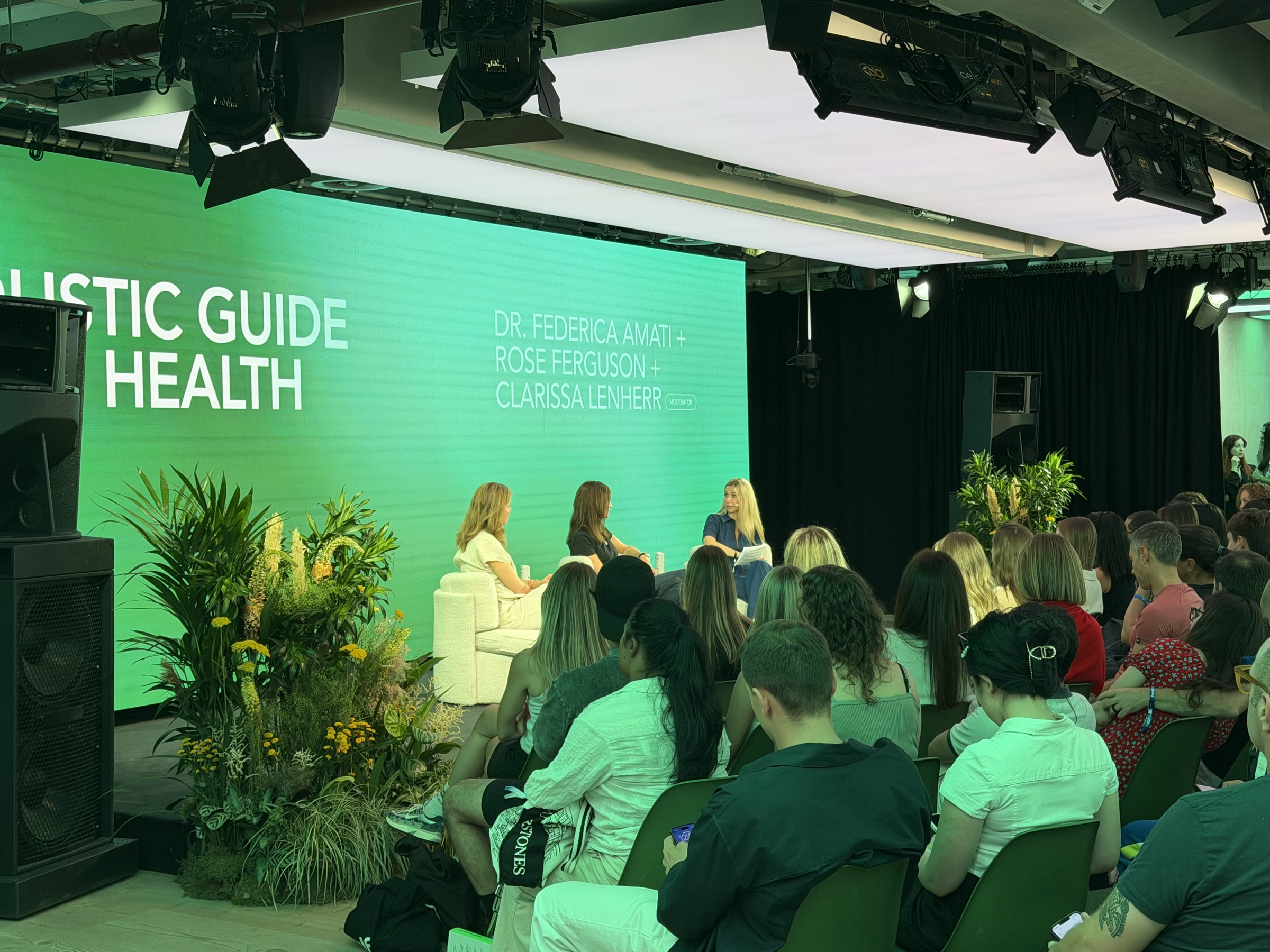

In a packed room in London this June, I listened to two of the most credible voices in British nutrition spend the first half of an hour cooling down the hottest drug story of the decade. GLP-1s, they agreed, can be genuinely life-changing. They are also, in Dr Federica Amati's flat phrasing, "not miracle drugs" — and what you do with your gut before, during and after deciding the difference between losing fat and losing your future health.
The occasion was a gut-health panel at Healf's HX26 conference, moderated by the nutritionist Clarissa Lenherr. On stage were Dr Federica Amati, head nutritionist and scientist at ZOE and author of a recent book on appetite, and Rose Ferguson, a functional-medicine nutritionist and Healf's resident practitioner. I was in the audience. What struck me was that neither of them did the thing the internet does with these drugs — neither cheerleading nor scaremongering. They talked about the gut, because the gut is where these medicines do most of their work and where most of the damage gets done.

That is why we are building a five-part series, Trust Your Gut, off this single conversation. And we are starting where the room's energy was highest: the GLP-1 question almost everyone now has a personal stake in. This piece lays out the sober version, the muscle problem nobody mentions at the point of sale, and the simple three-phase framework Amati uses to make the drugs work the way the trials say they can.
Not a Miracle, and Not for Everyone
Ferguson started with the upside, because it is real. "When you take a GLP-1, it literally blocks your appetite so you don't feel hungry," she said. For people who have spent years fighting constant food noise, "that noise goes — for a lot of people, that is actually a game changer." Nobody on the panel disputed that the drugs can transform the lives of people with obesity or type 2 diabetes.
But Amati, who runs a clinic full of exactly those patients, was quick to puncture the idea that they are a universal fix. "The one thing that I think isn't spoken about enough is that these drugs don't work for everyone," she said. "Even in the clinical trials, up to 20% of patients are non-responders." She described patients who had paid out of pocket for six months "with zero change to their metabolic health" — an outcome that is, in her words, "devastating for self-esteem."
These aren't miracle drugs. They don't work for everybody, they're not appropriate for everybody. Even with the patients who do have the conditions these drugs are made for, you need continuous oversight.
Ferguson's worry was different and, to my ear, the more uncomfortable one: the drift from medicine to cosmetic. "It's become like an aesthetic medication rather than a functional medication, which is what it was written for," she said — people "really in good shape" asking for a GLP-1 to "trim down for a holiday." She also relayed a statistic from Amati that reframed the whole conversation for me. Only around 5% of GLP-1 prescriptions in the UK come through the NHS. The other 95% are private or, increasingly, ordered online in a few clicks — which means the medical oversight both women kept insisting on is, for most users, simply absent.
The Muscle Problem Nobody Mentions
If there was one passage that made the room go quiet, it was Ferguson on what happens to your body when appetite is switched off but nutrition is not switched on. The drug stops the hunger signal; it does not stop the need. "You're not hungry, you don't think you're hungry," she said, "but your body is absolutely starving. Every cell in your body is going: feed me."
So it will take whatever nutrients it can from you. It will take your muscles; it will use your bones for a little bit of nutrition. It's quick to lose your muscle mass — and to get it back can be really challenging.
This is the mechanism behind the phenomenon the tabloids christened "Ozempic face," and Ferguson noted, drily, that the muscle-loss panic of a couple of years ago "scared a lot of people" — enough that clients now come to her before they start, not after the damage is done. The clinical concern underneath the aesthetics is real: a meaningful fraction of the weight lost on these drugs is not fat but lean tissue — muscle and, with it, bone.
Amati used this to make a point that has only just become official guidance. "Just last week, the new guidelines on obesity came out," she said, "and it's so much more about body composition and visceral fat accumulation than it is about weight alone." Lose weight badly — shedding muscle, regaining fat — and you can end up heavier in fat percentage than you started, even at a lower number on the scale. Lose it well, and you protect the metabolic machinery that keeps the weight off.
Her conclusion was almost startlingly empowering. If you nourish the gut, eat enough protein, and resistance train, "that risk of sarcopenic obesity, of visceral fat accumulation, reduces." And for some people, doing that work first changes the decision entirely: "they may not take the drugs — they might actually find that their endogenous signalling is enough." Which is exactly where Part 2 of this series goes: the appetite hormones your own gut makes for free.
Before, During, After: The Framework
The most useful thing Amati gave the room was a way to think about the whole journey rather than just the injection. "Pre, during and post," she said — "it's a really important way to frame it," because the gut's job is different in each phase. This is the portable tool from the talk, and the spine of how a good clinician actually supports someone on these drugs.
The most common reasons people quit are gastrointestinal: nausea, constipation, reflux. "If you go into taking these drugs already with constipation," Amati warned, "I guarantee you it's going to be worse." Building fibre diversity and returning to whole foods first lowers the odds of side effects severe enough to make you stop — and, she's found, some patients start losing weight in this prep phase and choose to delay medication altogether.
Every common side effect "is manageable with dietary intervention," Amati said: knowing what to do for reflux, for worsening constipation, before they drive you off the drug. The harder discipline is nutrition on near-zero appetite. As Ferguson put it, telling someone to "eat your fibre, eat your protein" is one thing — but "you're talking to someone who has zero appetite." Prioritising protein and fibre in the little you do eat, plus resistance training, is what preserves lean mass.
This, Amati said, "is the biggest piece," because most people do stop — and roughly three-quarters regain most of the weight within a year. The gut can be helped back to its own satiety signalling as the drug tapers, so the returning hunger is "less drastic." Ferguson's framing for the time on the drug is the one I keep coming back to: use it as a window to rebuild your relationship with food, "like a research project — when I'm stressed, do I eat? When I'm tired, do I eat?" Change nothing while you're on it, she warned, and "you come off them, nothing else has changed."
The Part the Trials Get Right
Amati's sharpest observation was about the gap between the clinical trials and real life. The headline results everyone quotes — the dramatic weight loss, the maintenance a year later — did not come from the drug alone. "In the randomised clinical trials of these drugs, they have psychotherapy support, nutritionist support, and exercise support," she pointed out. "The results from the trials are always better."
The trials are saying: look, people are maintaining their weight loss a year later. We should be doing it that way for everybody — giving people the tools to continue healthy weight loss, not just the prescription.
That is the quiet indictment of the click-to-order model. When the medicine arrives by courier with no nutritionist, no strength plan and no psychological support, you are not running the protocol that produced the famous numbers — you are running a stripped-down version of it, and then wondering why the real-world data on regain looks so much worse than the trials. The drug is the easy part. The support around it is what the trials were actually testing.
It is also, candidly, the model we built BODY HLTH's own GLP-1 care around. Where these medicines are clinically appropriate, we prescribe them through a supervised clinical consultation with the nutritional and lifestyle support the trials show is what actually makes them work — not dispensed and forgotten.
GLP-1 receptor agonists (semaglutide, tirzepatide and others) are prescription-only medicines. This article is educational and reports views expressed by Dr Amati and Rose Ferguson at a public event; it is not medical advice and not a recommendation to start, stop or change any medication. Where a GLP-1 is clinically appropriate, it should be accessed through a proper medical consultation with ongoing nutritional and clinical support — the supervised model the evidence above favours — rather than bought unsupported online.
The drug removes the appetite.
The gut decides the outcome.
What I took from Amati and Ferguson is that GLP-1s are neither the miracle nor the menace the internet insists on. They are a powerful tool whose result is determined almost entirely by the work around them — the fibre and whole foods that prepare the gut, the protein and resistance training that protect your muscle, and the relationship with food you rebuild while the noise is quiet.
Lose weight badly and you can end up metabolically worse off at a lower number on the scale. Lose it well and you keep what matters. The difference is gut work, before, during and after. Next in the series, the biology that makes it possible: the appetite hormones your own gut produces, and why most of us have switched them off.
- 01Wilding JPH, Batterham RL, Calanna S, et al. Once-weekly semaglutide in adults with overweight or obesity (STEP 1). New England Journal of Medicine. 2021;384(11):989-1002.
- 02Wilding JPH, Batterham RL, Davies M, et al. Weight regain and cardiometabolic effects after withdrawal of semaglutide: the STEP 1 trial extension. Diabetes, Obesity and Metabolism. 2022;24(8):1553-1564.
- 03Wadden TA, Bailey TS, Billings LK, et al. Effect of subcutaneous semaglutide vs placebo as an adjunct to intensive behavioral therapy on body weight (STEP 3). JAMA. 2021;325(14):1403-1413.
- 04Rubino F, Cummings DE, Eckel RH, et al. Definition and diagnostic criteria of clinical obesity. The Lancet Diabetes & Endocrinology. 2025;13(3):221-262.
- 05Gribble FM, Reimann F. Function and mechanisms of enteroendocrine cells and gut hormones in metabolism. Nature Reviews Endocrinology. 2019;15(4):226-237.
- 06Quotations are drawn from the gut-health panel at Healf's HX26 conference, with Dr Federica Amati and Rose Ferguson, moderated by Clarissa Lenherr, London, June 2026. Attributions reflect the views the speakers expressed at that event; clinical mechanisms and figures are sourced independently to the literature above. The ~5% NHS-prescribing and discontinuation figures were cited by the speakers and are consistent with current UK real-world prescribing data.