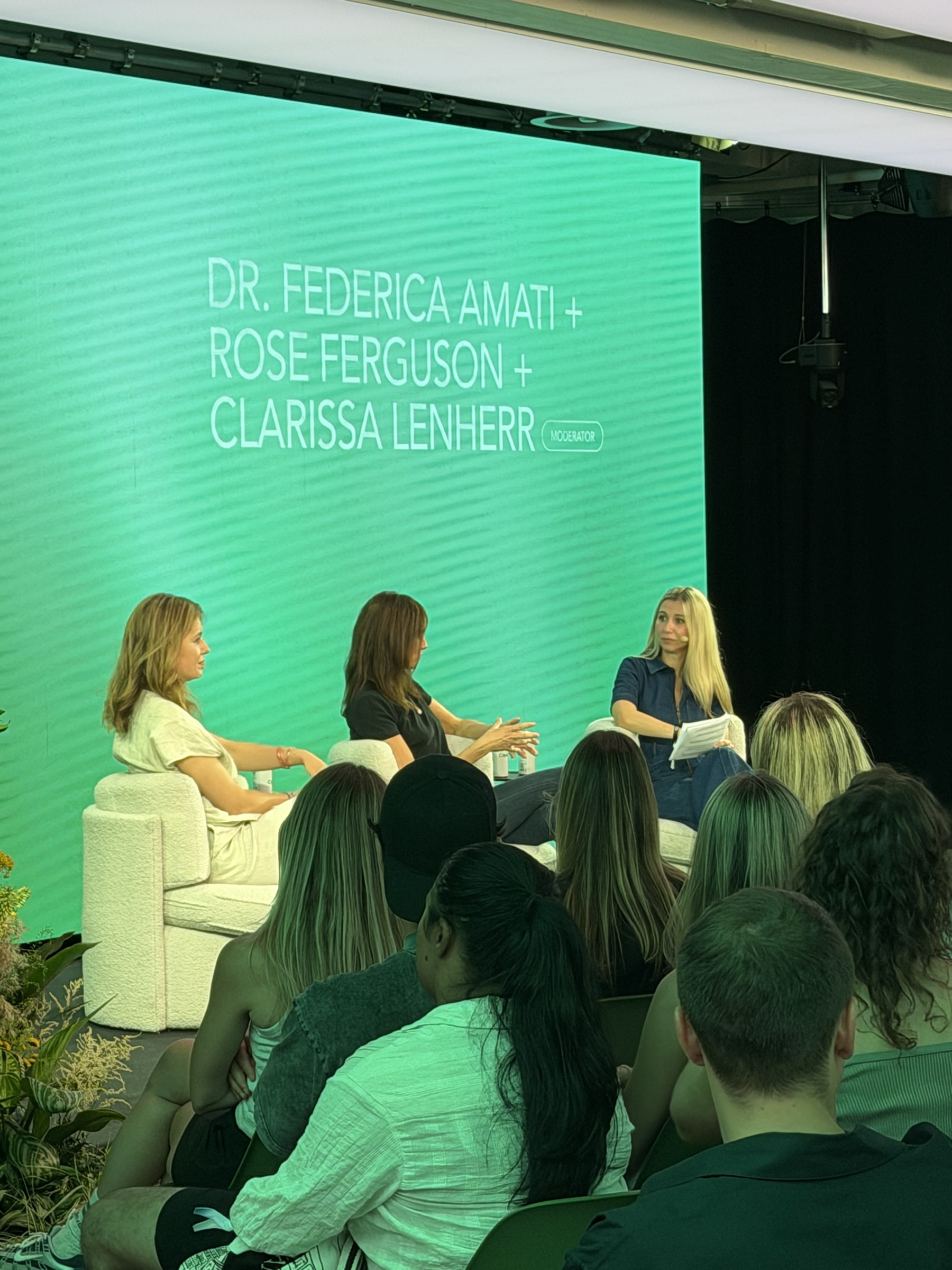

Almost everything in nutrition is an argument about what to eat. The most useful stretch of this panel was about something else entirely — the things you do around a meal that cost nothing and change how your body handles it. Rose Ferguson put it most bluntly: for all her love of high-tech gadgets, the interventions that actually move the needle are embarrassingly simple. It comes down, she said, to how you eat your food.
In Part 3 we covered what to put on the plate: diversity, fibre, fermented foods. This part is about the delivery — speed, posture, timing and rest. None of it requires a single new purchase, and Dr Federica Amati has the data to show it works.
Slow Down
The first lever is pace. Amati's team ran a large study on eating rate, and the result was clear enough to change how she advises everyone: the speed at which you eat predicts your metabolic response to the meal. Wolf the same plate down and more glucose and fat enter your bloodstream in a fast spike; eat the identical food slowly and the same nutrients arrive gently. Same meal, different physiology — decided entirely by the fork.
The speed at which you eat is very predictive of your postprandial response. Just slowing down your eating rate can decrease the amount of blood glucose and blood fat that enters quickly.
Ferguson's version was characteristically practical: chew your food. Grazing all day and inhaling meals were the two habits she flagged first when asked what people get wrong. The fix costs nothing — put the fork down between mouthfuls, chew properly — and it stacks neatly with the biology from Part 2: satiety hormones take around twenty minutes to register, so eating slowly is also how you give the "I'm full" signal time to arrive before you have overeaten.
Walk After You Eat
The second lever got the warmest laugh of the night. Amati's recommendation, borrowed from gastroenterologists and the internet alike, is the post-meal walk — or, as it has been affectionately branded, the "fart walk." Behind the joke is real physiology. The gut, she explained, does not enjoy being folded at ninety degrees in a chair; movement and gravity help food move through it.
Stand up, get out of the ninety-degree squish, and go for a walk. Gravity is your friend — your gut loves gravity. It helps food move along.
There is a metabolic bonus on top of the digestive one. A short walk after eating means your muscles are actively pulling glucose out of the blood to fuel the movement — so, as Amati noted, you need less insulin to manage the same meal. It is one of the highest-return, lowest-effort habits in the whole of metabolic health: a few minutes on your feet after lunch and dinner, no equipment, no cost.
Give Your Gut a Clock
The third lever is timing, and here an audience question about breakfast opened up the richest material of the evening. Amati's framing was circadian: your body runs on internal clocks, and while light is their main input, meal timing is the second most powerful cue. Eat at wildly different times every day and you blunt the system; anchor your meals and you sharpen it.
Crucially, she defused the perfectionism. The exact hour does not matter: "I don't mind if it's 7am or 11:30," she said — what matters is the regularity, and that the window closes a few hours before sleep. Younger bodies have more metabolic flexibility and can break the rules more cheaply; the rest of us benefit from working with the morning's natural insulin rise rather than against it at night.
Give Your Microbes a Rest
Ferguson's contribution closed the loop. Two simple things, she said, make an outsized difference. The first is to give your microbes a rest — an overnight gap with no food, so the gut isn't digesting around the clock. "Don't eat, and then eat, and then sleep," she warned; the all-day-into-the-night grazing pattern never lets the system pause and reset.
Her second tip was one she had rediscovered in her own practice: if your digestion struggles, cook your main meal earlier in the day and keep the evening lighter. Eating your largest, most fibre-rich meal at lunch rather than late at night gives a sluggish gut a real helping hand — and it dovetails exactly with Amati's "finish earlier" timing principle.
There are such simple things which make such a huge difference. Chew your food. Give your microbes a rest. Those two things alone can change everything.
- 1Slow down and chew. Put the fork down between mouthfuls. The same meal eaten slowly produces a gentler glucose and fat response — and gives satiety hormones the ~20 minutes they need to register.
- 2Walk after meals. Even a few minutes. Gravity helps digestion, and working muscles pull glucose from the blood so you need less insulin. The single best-value habit there is.
- 3Keep an eating window. Aim for 10–12 hours; anchor breakfast to a consistent time; stop eating 2–3 hours before bed. Regularity beats the precise clock.
- 4Rest the gut overnight, eat bigger earlier. Don't eat-then-sleep. If digestion is poor, shift your main meal to the day and keep the evening light.
The plate is only half of it.
How you eat is the other half.
What I loved about this part of the night is that it hands back control without asking you to buy anything. The diversity from Part 3 is what you eat; this is how you deliver it — slowly, on your feet afterwards, in a regular window, with the night left free for rest. None of it is glamorous. All of it works, and most of it is free.
That completes the constructive half of the series — the GLP-1 reality, the biology, the food, and now the habits. The final part turns to the other job both experts kept circling: clearing away the noise. Cleanses, colonics, endless tests and the supplement stack — what's worth it, and what isn't.
- 01Sun L, Ranawana DV, Tan WJK, et al. The impact of eating methods on eating rate and glycemic response in healthy adults. Physiology & Behavior. 2015;139:505-510.
- 02Ohkuma T, Hirakawa Y, Nakamura U, et al. Association between eating rate and obesity: a systematic review and meta-analysis. International Journal of Obesity. 2015;39(11):1589-1596.
- 03Buffey AJ, Herring MP, Langley CK, et al. The acute effects of interrupting prolonged sitting with standing or light walking on postprandial glycemia. Sports Medicine. 2022;52(8):1765-1787.
- 04Reynolds AN, Mann JI, Williams S, Venn BJ. Advice to walk after meals is more effective for lowering postprandial glycaemia in type 2 diabetes. Diabetologia. 2016;59(12):2572-2578.
- 05Sutton EF, Beyl R, Early KS, et al. Early time-restricted feeding improves insulin sensitivity, blood pressure, and oxidative stress. Cell Metabolism. 2018;27(6):1212-1221.
- 06Jakubowicz D, Barnea M, Wainstein J, Froy O. High caloric intake at breakfast vs dinner differentially influences weight loss of overweight and obese women. Obesity. 2013;21(12):2504-2512.
- 07Quotations are drawn from the gut-health panel at Healf's HX26 conference, with Dr Federica Amati and Rose Ferguson, moderated by Clarissa Lenherr, London, June 2026. Attributions reflect the views the speakers expressed at that event, including the ZOE eating-rate study cited by Dr Amati; supporting trials are sourced independently to the literature above.