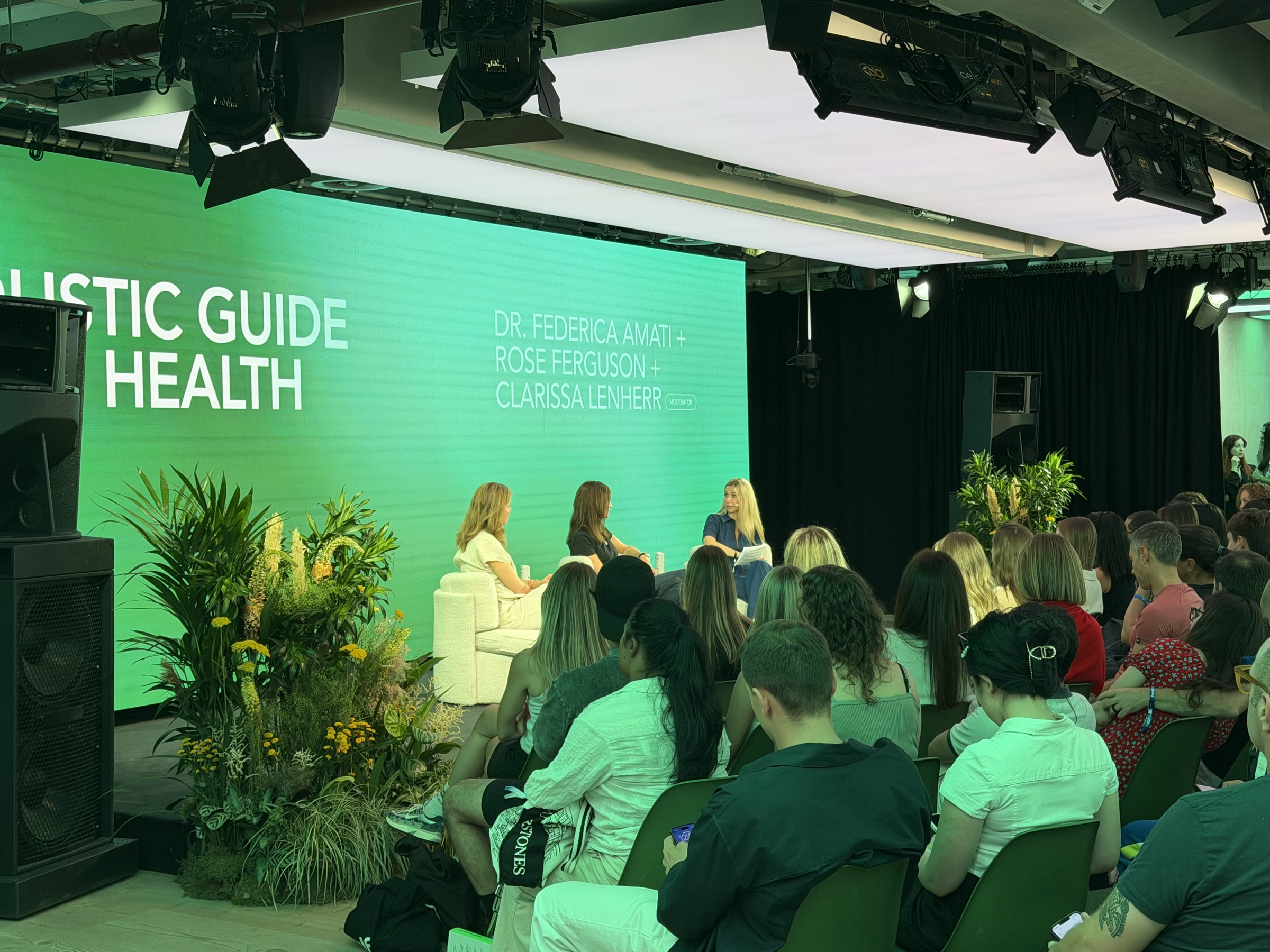

For all the talk of tests, drugs and devices, the word the panel kept circling back to was almost disappointingly simple. Not "probiotic." Not "cleanse." Diversity. If gut science has produced one finding robust enough to bet your habits on, both experts agreed, it is this — and it points in the opposite direction to almost everything the wellness industry sells.
In Part 2 we saw why the gut needs feeding: the nutrient-sensing L-cells that switch your appetite hormones on only fire when real food reaches them. This part is the what. And the answer Dr Federica Amati and Rose Ferguson gave is the one most likely to surprise anyone who has spent years cutting things out in the name of gut health.
The Myth That Does The Most Damage
Asked what clients consistently get wrong, both women named the same instinct from different angles. Ferguson's was the "probiotic as a fix-all" — the belief that a single supplement can undo whatever is wrong downstairs. Amati's was bleaker and, she said, the thing that does the most harm she sees in clinic: the conviction that gut health is achieved by removing food.
"A lot of people think that gut health is achieved by removing food groups," she said. "I'm not eating dairy anymore, I'm not eating gluten anymore, I'm not eating oxalates anymore" — a steady narrowing of the diet that, unless there is a genuine allergy or intolerance, does the precise opposite of what is intended. The microbiome is a population. Starve it of variety and you starve out species you needed.
Unless you have an allergy or genuinely can't tolerate a food, the diversity of your diet is the best predictor of good gut health. Eating as many different types of plants is so key. That's often where I see the most damage done.
It is worth sitting with how counter-cultural that is. The whole architecture of modern food anxiety is subtractive: the next thing to eliminate, the next category to fear. The science says the opposite. The goal is not a shorter list of "safe" foods; it is the longest, most varied list you can manage.
Why Diversity Wins
The mechanism is ecological, which is why Ferguson reaches for living metaphors — the microbiome as a Tamagotchi you carry everywhere and have to feed, or, in Amati's version, a flourishing garden. Different microbes eat different fibres. A diet built on the same five foods feeds the same handful of species; a diet built on dozens of plants feeds dozens of species, and a richer, more varied community is a more resilient one — better able to produce the full range of beneficial compounds, and to withstand the inevitable disruptions of antibiotics, illness and stress.
Thirty Plants a Week
Pressed for the three things people could start tomorrow, Amati's first was unhesitating: aim for 30 different plants a week. But she was careful to defuse the number before anyone turned it into another source of stress. "It's not a magical number," she said. "27 or 34 probably work just as well." The point is range, not a target to fail.
The reframe that makes it achievable is what counts as a "plant." Most people picture thirty vegetables and despair. Amati's definition is far broader: whole grains, legumes, nuts, seeds, herbs and spices all count — and you are not trying to eat thirty in a day, but across a week. "It doesn't mean you have to eat 30 types of fruit and veg every day," she stressed. A sprinkle of mixed herbs, a spoon of seeds on your porridge, a handful of mixed nuts: each is a point on the board.
Try to get 30 plants a week. It's not a magical number — 27 or 34 probably work just as well. Remember that plants include whole grains, legumes, spices, herbs, nuts and seeds.
- 1Everything counts as one point. Herbs, spices, nuts, seeds, whole grains and legumes are all plants. A teaspoon of mixed seeds is three points; a pinch of oregano is one.
- 2Diversify within a single meal. Mixed-bean stews, multi-grain bread, a salad of several leaves, a trail mix — these stack points fast without more cooking.
- 3Rotate the shop. Buy a different vegetable, grain or pulse each week. Tinned and frozen count exactly the same as fresh.
- 4Go low and slow. If you're starting from a low-fibre diet, ramp up gradually — leaping to a huge fibre intake overnight will leave you bloated. Build the diversity over weeks, not days.
Then Add Fermented Foods
Amati's second recommendation was to bring in fermented foods, and here she had data of her own to point to. At ZOE she ran a large trial — she cited around 10,000 participants — in which people added three portions of fermented food a day: "a bit of yoghurt, a bit of kefir, some miso or some sauerkraut." The reported improvements were broad: better mood and energy, and reductions in hunger, bloating and other gut symptoms.
The one caveat she flagged is histamine intolerance — for that minority, fermented foods can be a problem, and the advice doesn't apply. For everyone else, the controlled science backs the direction of travel.
It is also why both experts were cool on the reflex to reach for a probiotic capsule. As Amati put it, the myth that you can fix a disrupted gut by taking "a few probiotics" and having "a smoothie" misunderstands what the gut is. Recent guidance has even turned against routinely taking probiotics straight after antibiotics, because increasing fibre diversity and eating fermented foods does more, and lets the ecosystem recalibrate on its own. Food, not pills, is the lever. (We'll return to the supplement question properly in Part 5.)
You can't just take a few probiotics, have a smoothie, and fix it. It's an entire ecosystem. If it's disrupted, you really need to look after it.
Stop subtracting.
Start adding.
The most reassuring thing about the evening was that the best-evidenced advice in gut health is also the most generous. Not a regime of foods to fear and remove, but an invitation to eat more widely — thirty plants a week, counted loosely, herbs and spices and all; three small portions of something fermented a day; and a healthy scepticism toward any capsule that promises to do the work for you.
Diversity feeds the ecosystem, the ecosystem feeds you. It is the single biggest lever you have, and it costs nothing but variety. Next in the series, the finding that surprised the room most: that how you eat may matter as much as what.
- 01McDonald D, Hyde E, Debelius JW, et al. American Gut: an open platform for citizen science microbiome research. mSystems. 2018;3(3):e00031-18.
- 02Wastyk HC, Fragiadakis GK, Perelman D, et al. Gut-microbiota-targeted diets modulate human immune status. Cell. 2021;184(16):4137-4153.
- 03Valdes AM, Walter J, Segal E, Spector TD. Role of the gut microbiota in nutrition and health. BMJ. 2018;361:k2179.
- 04Suez J, Zmora N, Zilberman-Schapira G, et al. Post-antibiotic gut mucosal microbiome reconstitution is impaired by probiotics and improved by autologous FMT. Cell. 2018;174(6):1406-1423.
- 05Quotations are drawn from the gut-health panel at Healf's HX26 conference, with Dr Federica Amati and Rose Ferguson, moderated by Clarissa Lenherr, London, June 2026. Attributions reflect the views the speakers expressed at that event, including the ~10,000-participant ZOE fermented-foods cohort cited by Dr Amati; supporting mechanisms and trials are sourced independently to the literature above.