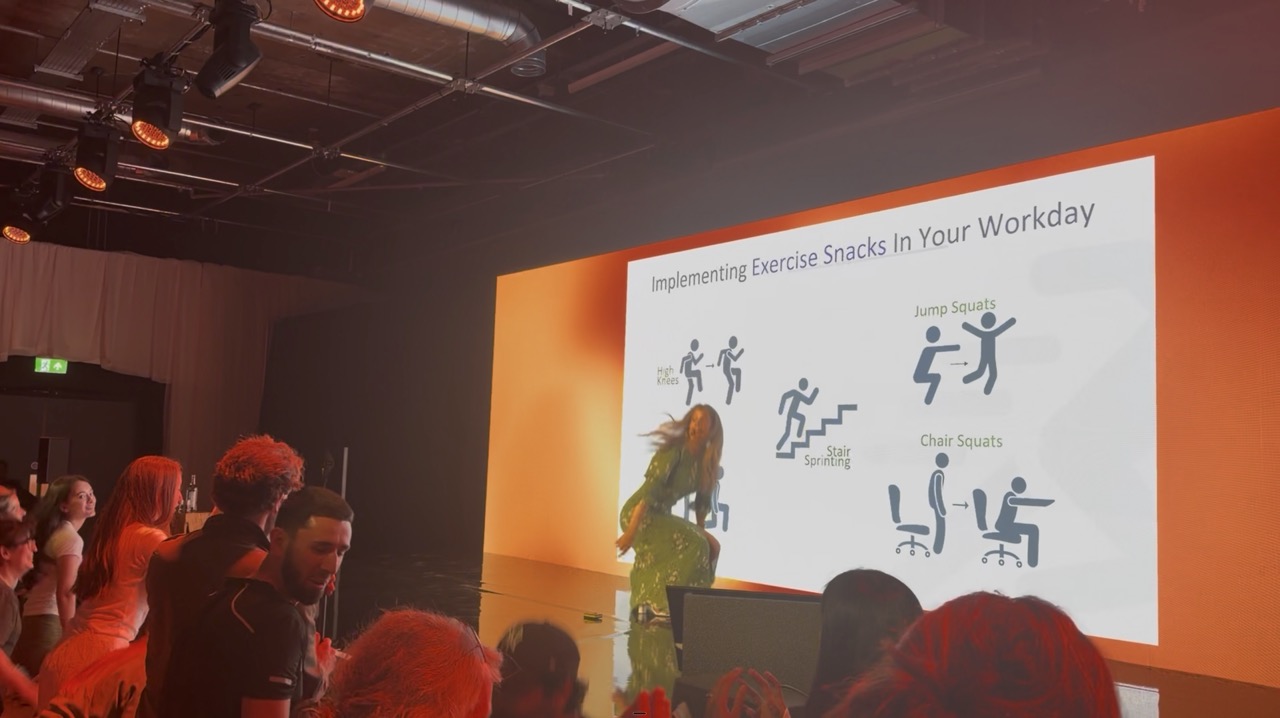
Near the end of her talk, Dr Rhonda Patrick did something no slide can do: she made several hundred people stand up and perform a minute of bodyweight squats. It was a piece of theatre with a point. Of all the longevity levers she had discussed — the vitamin D, the omega-3, the multivitamin, the sulforaphane — the one she rates most powerful is the one you cannot buy, bottle or swallow. It is vigorous physical activity, and the cardiorespiratory fitness it builds.
This is the fifth and final pillar of her "80/20" framework, and in a sense the keystone. The four that came before are about correcting deficiencies and switching on defences. This one is about the master variable — the single measurement that, across large studies, tracks how long people live more tightly than almost anything else a doctor can record.
"Being Sedentary Is a Disease"
That measurement is VO₂ max — the maximum rate at which your body can take in and use oxygen, the standard gauge of cardiorespiratory fitness. Patrick's central claim, drawn from a very large study of treadmill testing, is that fitness predicts mortality with startling force. People in the top tier of fitness had on the order of 80% lower all-cause mortality than the least fit — and, strikingly, the benefit kept climbing with fitness, with no ceiling at which being fitter stopped helping.
VO₂ max is the most powerful predictor of how long you're going to live. Being sedentary is a disease — being unfit was as strong a mortality risk as smoking or diabetes.
The flip side, she stressed, is that the steepest gains are at the bottom. Moving from "unfit" to merely "below average" buys more risk reduction than any drug on the market. The trouble is that the most common prescription — go for a brisk walk — doesn't, on its own, reliably raise VO₂ max. In studies of moderate activity, a substantial fraction of people, perhaps 40%, are "non-responders" whose fitness barely improves. The missing ingredient is intensity.
Reversing the Ageing Heart
The most vivid evidence Patrick cited came from the laboratory of Benjamin Levine. His team took sedentary middle-aged adults and put them through two years of progressive training that deliberately included high-intensity intervals. The result was a structural rejuvenation of the heart itself: the stiffening of the heart muscle that comes with a sedentary midlife was substantially reversed, leaving these participants with hearts that behaved, in Patrick's phrase, decades younger.
They took sedentary fifty-year-olds, trained them for two years, and the stiffening reversed — their hearts behaved decades younger. But you have to start before it's too late, and the intensity has to be there.
The protocol underneath much of this is the Norwegian 4×4: after a warm-up, four bouts of four minutes at a hard effort (around 90% of maximum heart rate), each followed by three minutes of easy recovery. It is the most studied way to raise VO₂ max efficiently, and it is where the "non-responders" to gentle walking finally start to respond.
Exercise Snacks: The Cheat Code
If two years of supervised training sounds daunting, Patrick's most democratising point was about how little it can take. A line of research on VILPA — vigorous intermittent lifestyle physical activity — tracked ordinary people through wearables and found that brief, incidental bursts of hard effort woven into daily life carried outsized benefits. The currency is generous: roughly one minute of vigorous activity is worth about four minutes of moderate for mortality.
You don't need a gym. One minute of vigorous activity is worth about four minutes of moderate — so take the stairs hard, carry the shopping, chase your kids. Those minutes count.
In the VILPA data, as little as three short bursts of around a minute each day — roughly nine minutes total — was associated with substantial reductions in all-cause and cardiovascular mortality. Climbing stairs at pace, a brisk uphill push, an all-out sprint for the bus: each is a tiny, free dose of the most powerful longevity drug there is. The point Patrick kept returning to is that intensity, not equipment or gym membership, is what matters.
The Brain Dividend
The final reason Patrick puts exercise at the top is that the same vigorous effort that protects the heart also feeds the brain — and the mechanism is, fittingly, that "waste" product. During hard exercise, muscles release lactate into the blood; it crosses into the brain and acts as both fuel and a signal, helping to drive the production of BDNF (brain-derived neurotrophic factor) — a protein Patrick likens to fertiliser for neurons. BDNF supports the growth of new connections and is tied to learning, memory and mood.
The downstream effects are measurable. A single ten-minute bout of vigorous activity can sharpen executive function and working memory for a window afterwards. Over the long term, aerobic training has been shown to increase the size of the hippocampus — the brain's memory hub, which otherwise shrinks with age — effectively buying back years of brain ageing. Exercise, on this view, isn't only the most powerful longevity drug; it is among the most powerful cognitive ones too.
- 1Know your number. VO₂ max is the marker to move — measurable in a lab, or estimated by most fitness watches. It's the longevity metric worth tracking over time.
- 2Add intensity, not just minutes. Once or twice a week, try the Norwegian 4×4: four minutes hard, three minutes easy, repeated four times. This is what lifts fitness when walking alone plateaus.
- 3Snack on vigour. Three roughly one-minute bursts a day — stairs taken hard, an uphill push, a sprint — are a free, time-efficient dose. One vigorous minute ≈ four moderate ones.
- 4Start where you are, and build. The biggest gains are at the bottom of the fitness scale. Progress gradually — the goal is frequent and vigorous over time, not heroic on day one.
This article is educational and reports views expressed by Dr Rhonda Patrick at a public event; it is not medical advice or an exercise prescription. Vigorous and high-intensity exercise carries risk if you have heart disease, uncontrolled blood pressure, or other conditions, or if you are new to intense activity. Speak to a qualified clinician before beginning a vigorous or high-intensity programme, and build up gradually. The mortality and heart-ageing figures come from observational studies and specific trials and describe group-level associations, not guarantees for any individual.
Five levers.
The biggest one is free.
That is Patrick's "80/20" in full: test and correct vitamin D; lift your omega-3 index; insure the gaps with a multivitamin; switch on your defences with sulforaphane; and, above all, get vigorously, regularly fit. Four of the five are about removing a shortfall. The fifth removes nothing — it adds capacity, and it happens to be the most powerful of all, costs nothing, and rewards the brain as richly as the body.
What struck me, sitting in that room as the whole audience caught its breath after a minute of squats, was how unglamorous the real longevity science turns out to be. No miracle, no secret. A short list of measurable, modest, mostly cheap things — done consistently. That's the whole game.
- 01Mandsager K, Harb S, Cremer P, et al. Association of cardiorespiratory fitness with long-term mortality among adults undergoing exercise treadmill testing. JAMA Network Open. 2018;1(6):e183605.
- 02Howden EJ, Sarma S, Lawley JS, et al. Reversing the cardiac effects of sedentary aging in middle age — a randomized controlled trial. Circulation. 2018;137(15):1549-1560.
- 03Stamatakis E, Ahmadi MN, Gill JMR, et al. Association of wearable device-measured vigorous intermittent lifestyle physical activity (VILPA) with mortality. Nature Medicine. 2022;28(12):2521-2529.
- 04Tjønna AE, Lee SJ, Rognmo Ø, et al. Aerobic interval training versus continuous moderate exercise as a treatment for the metabolic syndrome. Circulation. 2008;118(4):346-354.
- 05Erickson KI, Voss MW, Prakash RS, et al. Exercise training increases size of hippocampus and improves memory. Proceedings of the National Academy of Sciences. 2011;108(7):3017-3022.
- 06El Hayek L, Khalifeh M, Zibara V, et al. Lactate mediates the effects of exercise on learning and memory through SIRT1-dependent activation of BDNF. Journal of Neuroscience. 2019;39(13):2369-2382.
- 07Quotations are drawn from Dr Rhonda Patrick's talk, "The Science of Slow Ageing," at Healf's HX26 conference in London, June 2026. Attributions reflect the views the speaker expressed at that event; clinical mechanisms and figures are sourced independently to the literature above. Mortality and fitness figures derive from observational cohorts and specific trials and describe population-level associations; vigorous exercise should be undertaken with appropriate medical guidance.