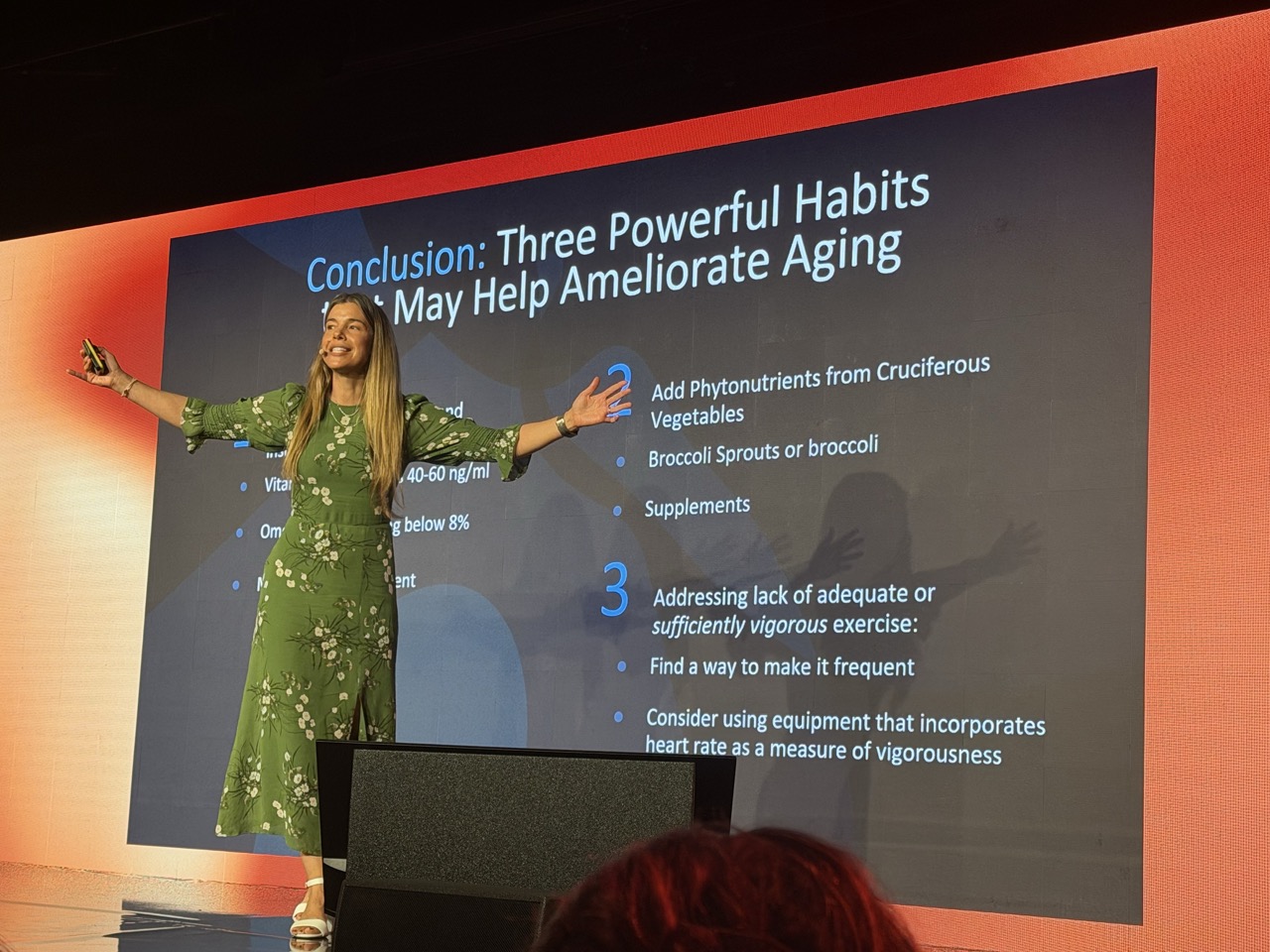

Dr Rhonda Patrick has a gift for taking a substance you thought you understood and showing you that you didn't. In a London lecture hall this June, she spent her opening minutes doing exactly that with vitamin D — a thing most of us think of as the stuff in a chewable tablet or a glass of fortified milk. Her point was sharper than a deficiency lecture: vitamin D is not really a vitamin at all. It is a hormone. And on her reading of the evidence, the majority of people in that room were almost certainly low.
I was in the audience at Healf's HX26 conference, not on the stage. Patrick — a biomedical scientist who founded the science-education project FoundMyFitness — had framed the whole talk around what she called an "80/20" approach to ageing: the small handful of interventions that deliver most of the benefit. "The goal," she said, "is to maintain your identity at eighty or ninety" — to keep the body and brain that make you you. Her first pillar was a short list of micronutrients she believes the science has earned the right to take seriously. Top of that list, and the subject of this first piece in our series, was vitamin D.
Not a Vitamin at All
The reframe she opened with is the one worth sitting with. A vitamin, strictly, is something your body can't make and must get from food. Vitamin D fails that definition on both counts: your skin manufactures it from sunlight, and once it's activated it stops behaving like a nutrient and starts behaving like a steroid hormone — chemically a close cousin of testosterone and oestrogen.
What a steroid hormone does is the part most people have never heard. It doesn't just sit in the bloodstream doing one narrow job. It travels into the cell, crosses into the nucleus where your DNA is kept, binds to a dedicated receptor, and acts as a switch on the genome itself.
It goes inside the nucleus, binds to its receptor, and turns genes on and off. We're talking about something that regulates over five percent of the human genome — more than a thousand genes.
Five percent does not sound dramatic until you remember the scale: the human genome runs to roughly twenty thousand genes, so this single hormone has a hand in the regulation of well over a thousand of them — genes governing immune function, cell growth, inflammation, and even Klotho, a gene so tied to longevity that researchers nicknamed it after the Greek Fate who spins the thread of life. When vitamin D is in short supply, all of that regulatory machinery runs on a lower setting.
Why Almost Everyone Is Low
If vitamin D is made from sunlight, why would a room full of health-conscious Londoners be deficient? Patrick's answer was a stack of modern realities, each of which quietly subtracts from the amount your skin can make.
We live indoors. We wear sunscreen, which by design blocks the very UVB wavelength that triggers synthesis. And we live, in London's case, at a latitude where the sun sits too low for much of the year to deliver any usable UVB at all — through the British winter, the skin essentially cannot make vitamin D regardless of how much daylight you stand in. Layer on the factors that reduce conversion even when the sun is out — older skin makes far less than young skin, more melanin slows synthesis, and body fat sequesters the hormone away from circulation — and Patrick's estimate that something like 70% of the population is insufficient stops sounding alarmist and starts sounding like arithmetic.
None of this is visible. You don't feel your VDR running quiet the way you feel a cold coming on. Which is what makes the hormone framing matter so much: if this were an ordinary vitamin, mild shortfall would be a minor accounting problem. Because it's a master regulator, a chronic shortfall is a slow, silent down-shift across a thousand genes — the kind of damage you only read in the long-term outcomes.
What It Means for the Ageing Brain
The outcomes Patrick spent most time on were neurological, and here a note of caution is owed before the numbers: much of this evidence is observational, the figures describe risk across populations rather than a guarantee for any one person, and association is not the same as proof. With that said, the signal she presented was hard to wave away.
The most persuasive strand comes from Mendelian randomisation — a method that uses inherited genetic differences in vitamin D levels as a natural, lifelong experiment, which gets closer to cause than a simple snapshot survey. By that approach, genetically lower vitamin D tracked with higher all-cause mortality and roughly a 50% higher risk of dementia. In observational cohorts, people who supplemented had on the order of 40% lower dementia risk than those who didn't.
People who were genetically predisposed to lower vitamin D had a much higher risk of dementia — and people who supplemented had around forty percent lower risk. That, to me, is not something to ignore.
She went further, into the language of biological ageing. In her telling, people deficient in vitamin D showed faster epigenetic ageing — the chemical wear-and-tear clock on your DNA — and correcting a deficiency in trial participants appeared to wind that clock back, by something on the order of two and a half years in one large randomised study she cited. She pointed, too, at brain imaging: reductions in the small white-matter lesions associated with cognitive decline as vitamin D levels rose, and a pair of randomised trials in people with mild cognitive impairment and Alzheimer's where even a modest 800 IU a day improved cognitive scores over a year.
How Much — and Why You Must Test
This is where Patrick became most practical, and most insistent on one point: do not guess. The dose she discussed for most adults was in the region of 4,000 to 5,000 IU a day, with blood targets framed in nanograms per millilitre — below 20 counts as deficient, and she favoured a comfortable sufficiency band of roughly 40 to 60, with anything above 30 broadly acceptable.
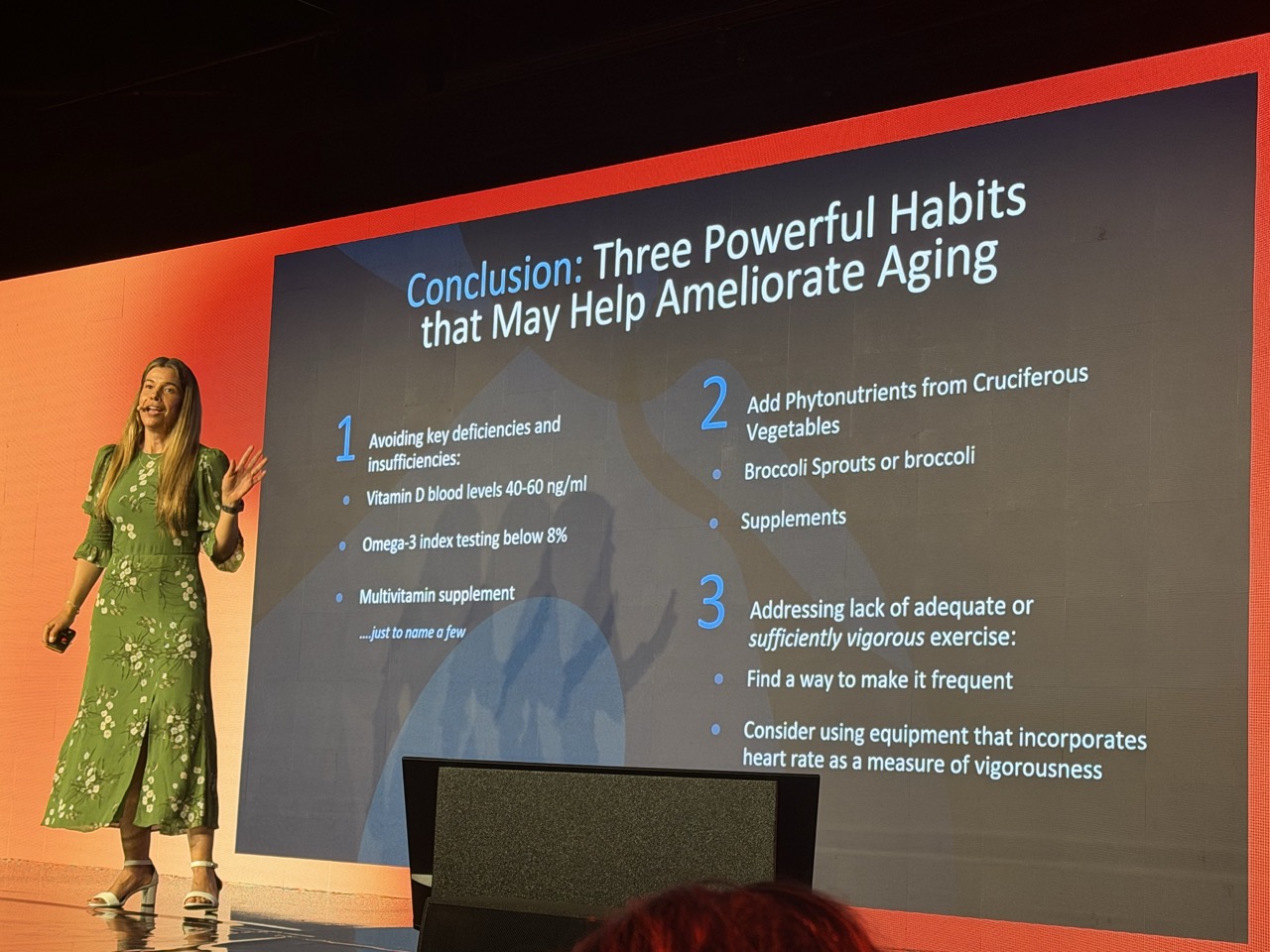
But the dose is not the headline. The headline is variation. Because of inherited differences in how people absorb and convert vitamin D, two people taking the identical dose can land at very different blood levels — some need far more than the textbook amount to get into range, others less. The only way to know which person you are is to measure. As she put it, the supplement is the easy part; the blood test is the part that makes it work.
Everybody is different in how they respond. You have to test your levels — take the dose, then check your blood after a month or two, because some people need a lot more than you'd think to get into the optimal range.
- 1Test before you trust a dose. Ask for a 25-hydroxyvitamin D blood test — the standard measure of your status. It's the only way to know where you actually stand, and most people have never had it checked.
- 2Know the bands. Below ~20 ng/mL is deficient; Patrick favours a sufficiency range of roughly 40–60, with above 30 broadly acceptable. Your clinician interprets your number against your own health picture.
- 3Re-test after a month or two. Because response varies so widely, a single dose doesn't predict a single result. Measuring again tells you whether you've actually reached range — or need to adjust.
- 4Don't mega-dose blind. Vitamin D is fat-soluble and accumulates; more is not automatically better, and very high intakes carry their own risks. The point of testing is to find your right amount, not the biggest one.
This article is educational and reports views expressed by Dr Rhonda Patrick at a public event; it is not medical advice and not a recommendation to start or change any supplement or treatment. The dementia, mortality and biological-ageing figures described here are drawn from observational and early-trial research — they describe associations across populations, not certainties for any individual, and vitamin D supplements are not a treatment for any disease. Vitamin D is fat-soluble and can build to harmful levels in excess. Always test your levels and consult a qualified clinician before starting or changing a supplement, particularly at higher doses or if you take other medication.
Stop thinking of it
as a vitamin.
The shift Patrick was asking for is small but it changes everything downstream. Treat vitamin D as a nutrient and a shortfall feels trivial. Treat it as a steroid hormone with its hand on more than a thousand genes — one that most of us, at this latitude and this lifestyle, are quietly running low on — and testing your level stops being fussy and starts being basic maintenance.
It is the first item on her 80/20 list precisely because the effort is so small and the reach so large. Next in the series, the second micronutrient she put on equal footing — the one she said being short of was, in mortality terms, "like smoking": omega-3.
- 01Holick MF. Vitamin D deficiency. New England Journal of Medicine. 2007;357(3):266-281. (Physiology, synthesis and prevalence.)
- 02Bouillon R, Marcocci C, Carmeliet G, et al. Skeletal and extraskeletal actions of vitamin D: current evidence and outstanding questions. Endocrine Reviews. 2019;40(4):1109-1151. (Genomic actions via the VDR.)
- 03Keisala T, Minasyan A, Lou Y-R, et al. Premature aging in vitamin D receptor mutant mice. Journal of Steroid Biochemistry and Molecular Biology. 2009;115(3-5):91-97.
- 04Navale SS, Mulugeta A, Zhou A, et al. Vitamin D and brain health: an observational and Mendelian randomization study. American Journal of Clinical Nutrition. 2022;116(2):531-540.
- 05Jia J, Hu J, Huo X, et al. Effects of vitamin D supplementation on cognitive function and blood Aβ-related biomarkers in older adults with mild cognitive impairment. Journal of Neurology, Neurosurgery & Psychiatry. 2019;90(12):1347-1352.
- 06Littlejohns TJ, Henley WE, Lang IA, et al. Vitamin D and the risk of dementia and Alzheimer disease. Neurology. 2014;83(10):920-928. (White-matter and cognitive associations.)
- 07Quotations are drawn from Dr Rhonda Patrick's talk, "The Science of Slow Ageing," at Healf's HX26 conference in London, June 2026. Attributions reflect the views the speaker expressed at that event; clinical mechanisms and figures are sourced independently to the literature above. The epigenetic-ageing and prevalence figures were cited by the speaker; the dementia-risk figures derive from Mendelian-randomisation and observational research and describe population-level associations, not individual outcomes.