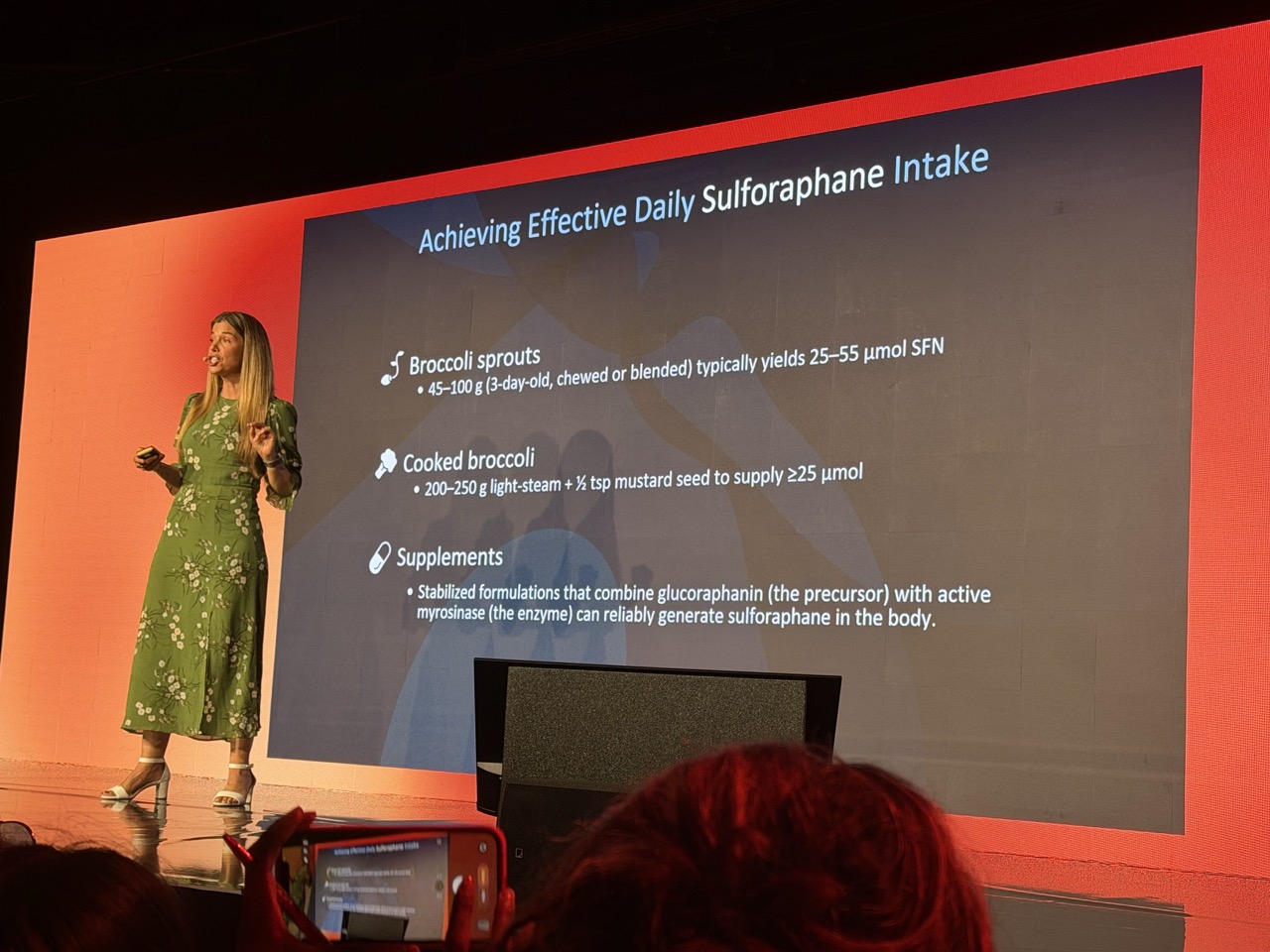
If Dr Rhonda Patrick has a signature obsession, it is a question she keeps asking audiences, half-teasing and entirely serious: are you eating your broccoli sprouts? Behind the question is a molecule she has spent years studying — sulforaphane — and a piece of chemistry that is genuinely elegant. It isn't in the broccoli when you buy it. You manufacture it, in your own mouth, the moment you bite down.
With the micronutrient trio of vitamin D, omega-3 and the multivitamin covered, Patrick's talk turned from filling gaps to something more active: switching on the body's own defence systems. Sulforaphane is her prime example — a plant compound that doesn't supply antioxidants so much as instruct your cells to make their own, in bulk, for days at a time.
The Molecule You Make by Biting
Cruciferous vegetables — broccoli, kale, cabbage, cauliflower, bok choy — store a stable precursor called glucoraphanin in one compartment, and an enzyme called myrosinase in another. They are kept apart until something damages the plant. When you chew (or chop, or an insect bites), the two meet and the enzyme converts the precursor into sulforaphane — the plant's chemical alarm, and the active compound we care about. It is, quite literally, a defence the plant only deploys when attacked.
The richest source is not mature broccoli but broccoli sprouts — the three-day-old seedlings — which Patrick noted can contain on the order of 100 times more of the precursor than the grown vegetable. A small handful of sprouts can rival a large head of broccoli.
Are you eating your broccoli sprouts? It's the single most concentrated source of this compound — and it's something you can grow on your kitchen counter.
The Master Switch: NRF2
What makes sulforaphane interesting isn't that it's an antioxidant — it largely isn't, in the direct sense. Its power is that it activates NRF2, a transcription factor that sits like a master switch over the cell's stress-defence programme. Flip that switch and the cell turns up hundreds of protective genes at once.
It flips on this master regulator, NRF2, and your cells start making their own antioxidant and detox enzymes — and they keep working for days. That's a fundamentally different thing from swallowing an antioxidant pill.
What It Does in Humans
The human evidence Patrick leaned on is about detoxification and DNA protection, and it is unusually concrete. In a landmark study in a heavily polluted region of China, people drinking a daily broccoli-sprout beverage excreted significantly more of the airborne carcinogens benzene and acrolein — direct evidence that the phase-2 enzymes were doing their job. Controlled feeding studies have likewise reported meaningful reductions in markers of DNA damage when people eat substantial amounts of cruciferous vegetables.
Patrick also discussed the early-stage cancer-prevention research — including a small trial in men with prostate cancer where sulforaphane appeared to slow the rate at which PSA rose, and a large body of promising laboratory and animal work. But she was conspicuously careful here, and so will we be. This is preliminary, mechanism-and-prevention research; it is emphatically not evidence that sulforaphane treats cancer.
If somebody had cancer, I'm not going to tell them to take sulforaphane. That's not what this is. This is about prevention and detoxification — the everyday protection.
How to Actually Get It
The practical catch is that this elegant chemistry is fragile. Heat destroys myrosinase, the enzyme that makes sulforaphane — so boiling broccoli to death gives you very little. Patrick's favourite workaround is a genuinely useful kitchen hack: sprinkle a little mustard-seed powder (mustard is also cruciferous and carries active myrosinase) onto cooked broccoli, which can restore conversion several-fold. Better still, eat some of it raw, or grow sprouts.
- 1Broccoli sprouts are the richest source. A small daily handful — easy to grow on a windowsill — delivers far more precursor than mature broccoli.
- 2Chop and wait. Cutting or chewing raw cruciferous veg and letting it sit ~40 minutes before any heat gives the enzyme time to make sulforaphane.
- 3Use the mustard-seed hack. A pinch of mustard powder on cooked broccoli restores much of the conversion lost to heat — Patrick cites roughly a four-fold improvement.
- 4Supplements vary widely. Stability is genuinely tricky; if you supplement, look for products standardised to deliver active sulforaphane (glucoraphanin plus active myrosinase), and treat it as a food compound, not a medicine.
This article is educational and reports views expressed by Dr Rhonda Patrick at a public event; it is not medical advice. Sulforaphane is a food-derived compound studied for detoxification and cancer prevention — it is not a treatment for cancer or any other disease, a limit Dr Patrick herself was explicit about. The cancer-related findings described here are early-stage laboratory, animal and small-trial research. Cruciferous vegetables and concentrated supplements may interact with certain conditions or medications. Consult a qualified clinician before taking concentrated sulforaphane supplements, especially if you are pregnant, have a thyroid condition, or are undergoing any medical treatment.
Don't supply antioxidants.
Switch on your own.
Sulforaphane reframes what a "healthy compound" can do. Rather than donating a single antioxidant, it presses NRF2 — the master switch — and lets your cells run their own defence and detox machinery for days. The human evidence is strongest for detoxification and DNA protection; the cancer research is promising but preliminary, and Patrick was the first to say so. The action item is refreshingly low-tech: eat the sprouts, chop and wait, keep the mustard powder handy.
Four pillars down — three micronutrients and one phytochemical. The fifth is the one Patrick called the most powerful of all, and it isn't something you swallow. Next: vigorous exercise, and why VO₂ max may be the single best predictor of how long you live.
- 01Fahey JW, Zhang Y, Talalay P. Broccoli sprouts: an exceptionally rich source of inducers of enzymes that protect against chemical carcinogens. Proceedings of the National Academy of Sciences. 1997;94(19):10367-10372.
- 02Egner PA, Chen JG, Zarth AT, et al. Rapid and sustainable detoxication of airborne pollutants by broccoli sprout beverage: results of a randomized clinical trial in China. Cancer Prevention Research. 2014;7(8):813-823.
- 03Houghton CA. Sulforaphane: its "coming of age" as a clinically relevant nutraceutical in the prevention and treatment of chronic disease. Oxidative Medicine and Cellular Longevity. 2019;2019:2716870.
- 04Cipolla BG, Mandron E, Lefort JM, et al. Effect of sulforaphane in men with biochemical recurrence after radical prostatectomy. Cancer Prevention Research. 2015;8(8):712-719.
- 05Gill CIR, Haldar S, Boyd LA, et al. Watercress supplementation in diet reduces lymphocyte DNA damage. American Journal of Clinical Nutrition. 2007;85(2):504-510.
- 06Dosz EB, Jeffery EH. Modifying the processing and handling of frozen broccoli for increased sulforaphane formation (mustard-seed myrosinase). Journal of Food Science. 2013;78(9):H1459-H1463.
- 07Quotations are drawn from Dr Rhonda Patrick's talk, "The Science of Slow Ageing," at Healf's HX26 conference in London, June 2026. Attributions reflect the views the speaker expressed at that event; clinical mechanisms and figures are sourced independently to the literature above. The cancer-related findings are early-stage prevention and laboratory research; sulforaphane is presented as a dietary compound for detoxification and chemoprevention research, not as a treatment for any disease.