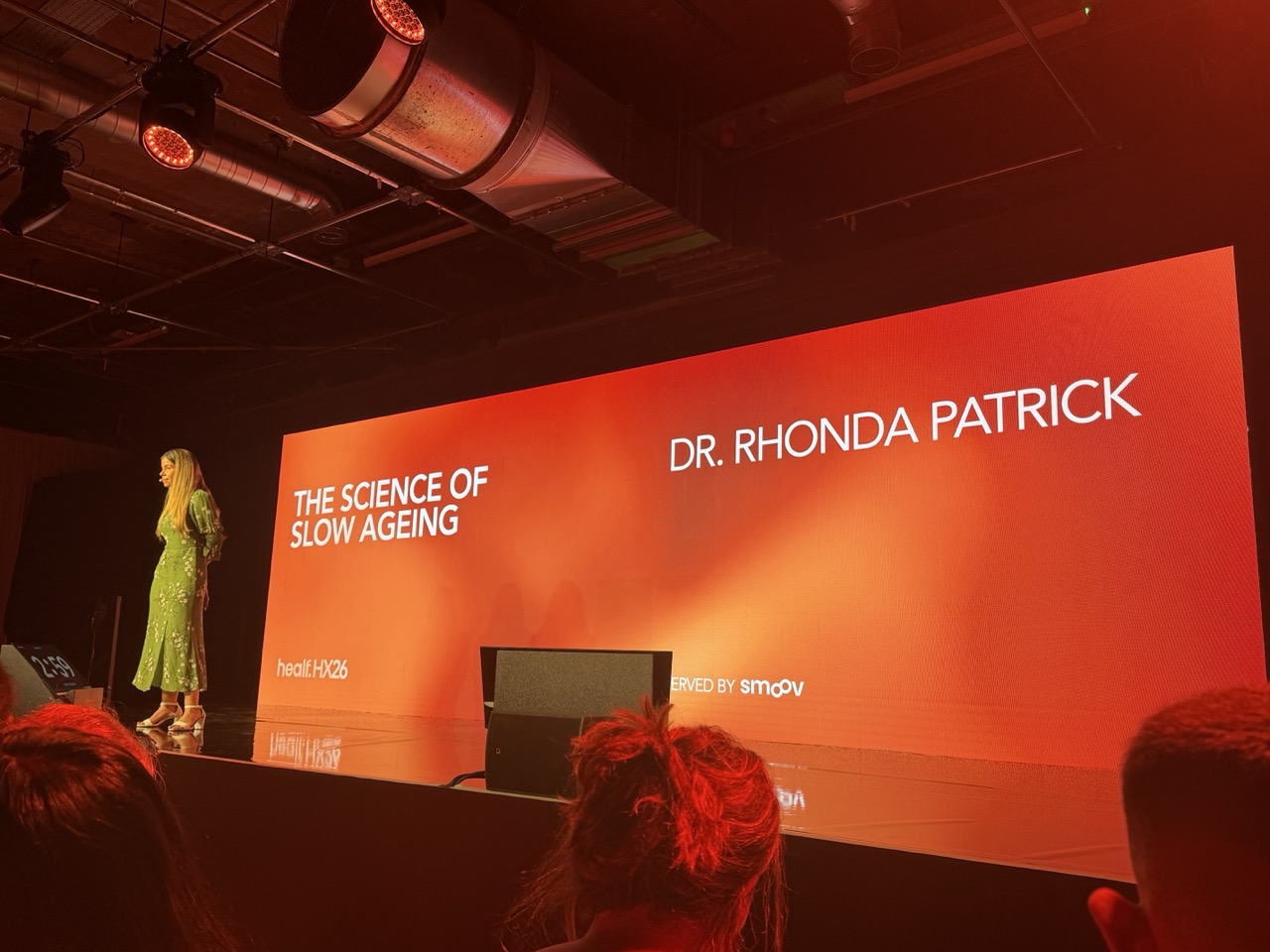

"Multivitamins are useless" is one of those things everyone seems to know. It has the ring of sophistication — the knowing dismissal of a mass-market product, the implication that real health comes from food, not pills. Dr Rhonda Patrick spent a portion of her Healf HX26 talk taking that consensus apart, and she did it not with anecdote but with two large, recent, randomised trials. Her verdict was blunt: the dismissal is out of date.
This is the third pillar in her micronutrient trio, after vitamin D and omega-3, and in some ways the most counter-cultural. Where those two are about correcting a single, measurable deficiency, the multivitamin is about something humbler and harder to see: the steady accumulation of small gaps across many nutrients at once, in a population that mostly believes it eats well enough.
The Most Mocked Pill in the Aisle
Patrick's starting point was that the "useless" verdict rests on the wrong trials. Many older studies asked whether multivitamins prevent heart attacks or cancer in already well-nourished people — a high bar, and largely a null result. What changed the picture, she argued, was a newer generation of trials designed to look at cognitive ageing, where the results have been quietly remarkable.
People love to say multivitamins are useless. The recent randomised controlled trials say otherwise — particularly when it comes to the ageing brain.
The trials she meant are the COSMOS studies — a set of large, placebo-controlled investigations in older adults. Their sub-studies on memory and cognition found that a bog-standard daily multivitamin, the kind sold in any pharmacy, measurably slowed aspects of brain ageing over the course of the trials. We will come to the numbers; the point she pressed first is that the evidence base moved, and the popular wisdom didn't move with it.
The Gaps You Can't See
Why would a multivitamin help people in a wealthy country with abundant food? Because abundance and nutrient density are not the same thing. A diet heavy in ultra-processed food can deliver more than enough calories while quietly running short on the vitamins and minerals that calories used to come packaged with. Patrick reeled off the inadequacy figures from national dietary surveys: large fractions of the population fall below the estimated requirement for magnesium, vitamin E, vitamin K and others — not dramatic, clinical deficiency, but chronic, sub-optimal intake.
One of Patrick's explanations deserves a careful footnote. She attributes part of the gap to soil depletion — the idea that modern produce is less nutrient-dense than it was decades ago. In fairness, this claim is genuinely contested: long-term analyses are mixed, with meaningful declines in only a handful of minerals, and the narrative is sometimes amplified by people with something to sell. The driver that isn't in dispute is simpler and more actionable — we eat more ultra-processed food and fewer whole plants than we used to. On that, the science is settled, and it's the part worth acting on.
When you're chronically low on a nutrient, your body makes a choice — and it protects the short term. The damage is insidious. You don't see it, and then one day you do.
What the COSMOS Trials Actually Found
The headline results are the reason Patrick raised the topic at all. In the COSMOS cognitive sub-studies, a daily multivitamin — compared with placebo — was associated with a slowing of measures of brain ageing on the order of two years for global cognition, and a larger effect on episodic memory, the kind of remembering that fades first with age. The benefit was most pronounced in people who started with poorer diets, which fits the gap-filling logic exactly.
How to Think About It
None of this makes the multivitamin a hero, and Patrick was careful not to oversell. A pill does not replace a diet rich in whole plants, oily fish and the thousands of beneficial compounds that no tablet contains — and it certainly doesn't license a bad one. The honest framing is the unglamorous one: a broad-spectrum multivitamin is cheap insurance against the gaps a real, imperfect diet leaves behind.
It's not a replacement for a good diet. It's an insurance policy for the gaps — and most people, whether they admit it or not, have gaps.
- 1Food first, pill second. A multivitamin fills gaps; it doesn't replace whole foods or excuse a poor diet. Build the plate first, then insure it.
- 2Choose a complete, broad-spectrum formula. The COSMOS benefit came from an ordinary, comprehensive daily multivitamin — not a megadose of any single nutrient.
- 3Test depth, supplement breadth. A multi covers many nutrients at modest doses; the big individual players worth measuring and targeting separately — vitamin D, omega-3, ferritin, B12 — are the ones from the rest of this series.
- 4Mind the fat-soluble and iron content. Vitamins A and E accumulate, and added iron isn't right for everyone. Match the formula to you — ideally with a clinician's input.
This article is educational and reports views expressed by Dr Rhonda Patrick at a public event; it is not medical advice and not a recommendation to start or change any supplement. The cognitive findings come from specific randomised trials in older adults and are modest in size; a multivitamin is not a treatment for, or protection against, dementia or any disease. Some nutrients — including vitamin A, vitamin E and iron — can be harmful in excess or in particular conditions (for example, iron in haemochromatosis). Consult a qualified clinician before starting a supplement, especially if you are pregnant, take other medication, or have a chronic condition.
Not a hero.
Cheap insurance.
The fashionable dismissal of the multivitamin was always a little too pleased with itself. Patrick's case isn't that the pill is magic — it's that the modern diet leaves real, invisible gaps, that those gaps do slow damage through mechanisms like triage, and that recent trials show a cheap daily multivitamin measurably helps the ageing brain. Unglamorous, low-cost, evidence-backed: exactly the profile of an 80/20 intervention.
That completes the micronutrient trio. Now the series turns from filling gaps to switching on defences. Next: sulforaphane, the compound in broccoli sprouts that activates the body's own master antioxidant system.
- 01Baker LD, Manson JE, Rapp SR, et al. Effects of cocoa extract and a multivitamin on cognitive function: the COSMOS-Mind randomized clinical trial. Alzheimer's & Dementia. 2023;19(4):1308-1319.
- 02Yeung LK, Alschuler DM, Wall M, et al. Multivitamin supplementation improves memory in older adults: a randomized clinical trial (COSMOS-Web). American Journal of Clinical Nutrition. 2023;118(1):273-282.
- 03Vyas CM, Manson JE, Sesso HD, et al. Effect of multivitamin-mineral supplementation on cognitive decline: a meta-analysis of the COSMOS cognitive trials. American Journal of Clinical Nutrition. 2024;119(3):692-701.
- 04Ames BN. Low micronutrient intake may accelerate the degenerative diseases of aging through allocation of scarce micronutrients by triage. Proceedings of the National Academy of Sciences. 2006;103(47):17589-17594.
- 05Reider CA, Chung R-Y, Devarshi PP, et al. Inadequacy of immune health nutrients: intakes in US adults, NHANES 2005-2016. Nutrients. 2020;12(6):1735.
- 06On soil-nutrient decline: Marles RJ. Mineral nutrient composition of vegetables, fruits and grains: the context of reports of apparent historical declines. Journal of Food Composition and Analysis. 2017;56:93-103. (A measured review; declines are limited and contested.)
- 07Quotations are drawn from Dr Rhonda Patrick's talk, "The Science of Slow Ageing," at Healf's HX26 conference in London, June 2026. Attributions reflect the views the speaker expressed at that event; clinical mechanisms and figures are sourced independently to the literature above. The cognitive-ageing figures are from the COSMOS randomised trials and are modest in absolute terms; the soil-depletion explanation is noted as contested rather than presented as established fact.