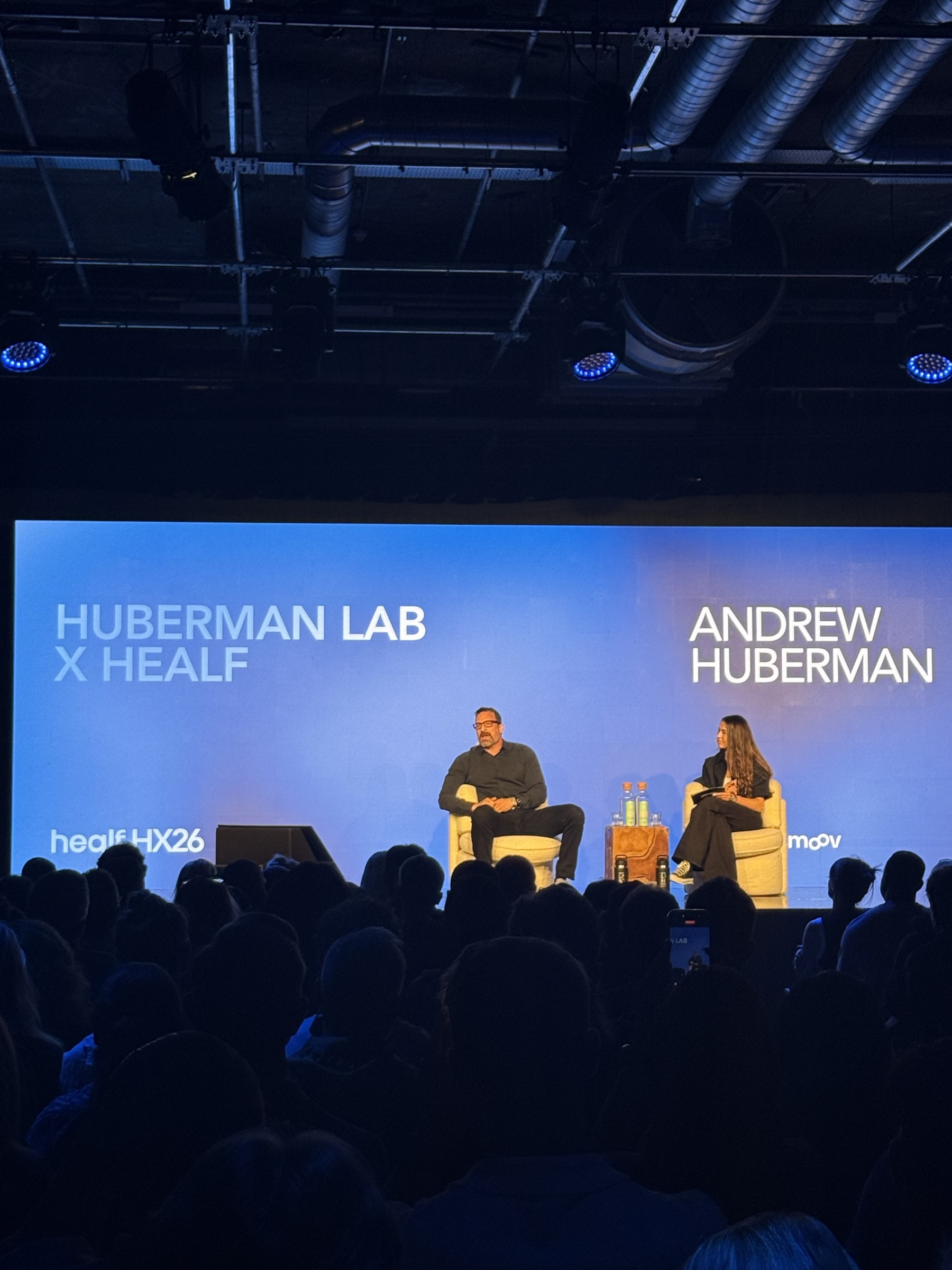

Ask most people about their morning routine and you will get a list: the cold plunge, the lemon water, the sunlight walk, the supplement tray, the journalling. In London, Andrew Huberman quietly dismantled the whole list and replaced it with a single instruction about the shape of the day. Stop counting the steps, he said. Get the two ends right.
It is the same move we have been making since Part 1: behind the proliferating routines sits one principle. Here the principle is about a hormone most people only meet as a villain. Cortisol is not the enemy. Mistimed cortisol is. Get the timing right and a dozen separate "morning habits" turn out to be doing one job.
The Shape of a Good Day
The body runs on a daily rhythm of cortisol and the catecholamines, the trio of dopamine, noradrenaline and adrenaline. What our species is built for, Huberman argued, is a large, early surge of these, ideally inside the first hour of being awake, then a steady fall through the afternoon to low levels at night. That is the whole pattern: a peak you bookend the morning with, and a trough you bookend the night with.
You want those molecules spiked big in the first hours of your day… and you want it dropping through the afternoon, and low at night. That's what's going to bookend your day.
Frame it this way and the daily question stops being "which of the fourteen things did I do?" and becomes "did I lift the morning and lower the night?" The individual tools, light, movement, caffeine, cold, are just different ways of pulling those two levers. Which is exactly the Part 1 test: find the shared mechanism, and the catalogue of techniques collapses into it.
The Morning Spike
Within the first 30 to 45 minutes of waking, cortisol rises sharply, a well-documented phenomenon called the cortisol awakening response. It is not a malfunction; it is the signal that starts your day, mobilising energy, sharpening focus, and setting the clock that everything downstream runs on. The single biggest trigger, Huberman noted, is simply getting up, and the biggest amplifier is light.
This is where the morning-light advice earns its keep. Bright light in the morning measurably increases the size of that cortisol surge, which is precisely the effect you want at that hour. Movement adds to it; so does caffeine. None of these are competing protocols, they are stacked amplifiers of the same morning lever. As Huberman put it, the spike "is primarily boosted by getting up… and bright light amplifies that."
The corollary is the night rule: bright, short-wavelength light in the evening suppresses melatonin and blunts the night-time fall you are trying to create. Same mechanism, opposite time of day.
Why the Spike Buys Stress Resilience
Here is the part that makes the morning effort worth it, and it is the opposite of how most people think about cortisol. A big, clean morning peak is what allows cortisol to be low later. And a low afternoon and evening baseline is what lets you absorb stress without it wrecking your sleep.
When a stressor hits on top of an already-low baseline, the spike it causes is temporary and you recover quickly. When it lands on top of a baseline that is still elevated, because the rhythm is flat or peaking too late, the stress stacks, stays high into the evening, and starts to corrode sleep. Do that night after night and you are into the chronic-stress, poor-sleep spiral Huberman warned about.
What you don't want is a big flat or sort of humped cortisol curve. Because then if you have stress, it's on top of that elevated level in the afternoon and at night, and you start getting into chronic sleep issues.
So the morning spike is not about being wired at 7am. It is an investment in being calm at 10pm and resilient at every stressful moment in between. Cold exposure, sauna, a hard early workout, Huberman's point was that these are simply "wonderful tools to create these spikes", not ends in themselves.
The Low Night
The other bookend is quieter and, for most people, more neglected. As the evening comes, you want cortisol and the catecholamines falling and the night-time signals, melatonin and serotonin, rising. The single most disruptive thing you can do is flood your eyes with bright, short-wavelength light late at night, which suppresses melatonin and props the system up exactly when it should be powering down.
The practical version is unglamorous: dim the lights in the last hours, keep evening light warm and low, and make the bedroom dark and cool. You are not adding a protocol; you are removing an interference. The night bookend is mostly about subtraction.
The British Winter Problem
Most longevity advice is written under a Californian sun, and it quietly assumes you can step outside into bright morning light whenever you like. In the UK, for several months of the year, you cannot. In midwinter the sun rises late, sits low, and is often hidden behind cloud; many people leave for work in the dark and the morning light signal that is meant to build the cortisol spike barely arrives.
This is where the principle, rather than a rigid protocol, saves you, because it tells you what you are actually trying to achieve and lets you improvise. Two facts make it workable. First, outdoor light is dramatically brighter than indoor light even under heavy cloud, often by a factor of ten or more, so a few minutes outside still beats sitting by a window. Second, when natural light genuinely is not available, bright artificial light can stand in for it. Huberman was open that he uses consumer indoor-lighting tools for exactly this (he named brands such as BON CHARGE, with, he stressed, no affiliation and paying full price like anyone else).
The British answer, then, is not to abandon the morning bookend but to hit it by any route available: get outside early even when it is grey, keep a consistent wake time so the rhythm has an anchor, add movement and caffeine as amplifiers, and use bright artificial light on the darkest mornings. In Huberman's recurring phrase, "do what you can, when you can" — the principle holds even when the Tuscan-sun version of it does not.
The Protocol: Bookend the Day
Reduced to its two levers, the whole thing fits on a postcard. Lift the morning; lower the night. Everything else is a means to one of those ends.
Keep a consistent wake time as the anchor. Get into daylight early, outside beats a window, and grey still counts. Add movement and, if you use it, caffeine as amplifiers. On dark winter mornings, bright artificial light stands in for the sun.
This bookend is mostly subtraction: dim the lights, keep evening light warm and low, avoid bright screens close to bed, and make the bedroom dark and cool. You are removing the interference that keeps cortisol propped up.
Two bookends.
Everything else is detail.
The morning-routine arms race dissolves into one principle: spike cortisol and the catecholamines early, let them fall to a genuine low at night. A clean morning peak is what buys you a calm evening and the resilience to absorb stress in between. The tools, light, movement, caffeine, cold, dark, are interchangeable; the shape is what matters, and it holds even through a London December.
Next, the discipline that keeps all of this honest. Part 4 turns to wearables and self-measurement, and Huberman's rule for tracking your body without letting the numbers do you harm.
- 01Leproult R, Colecchia EF, L'Hermite-Balériaux M, Van Cauter E. Transition from dim to bright light in the morning induces an immediate elevation of cortisol levels. Journal of Clinical Endocrinology & Metabolism. 2001;86(1):151-157.
- 02Clow A, Hucklebridge F, Stalder T, et al. The cortisol awakening response: more than a measure of HPA axis function. Neuroscience & Biobehavioral Reviews. 2010;35(1):97-103.
- 03Fries E, Dettenborn L, Kirschbaum C. The cortisol awakening response (CAR): facts and future directions. International Journal of Psychophysiology. 2009;72(1):67-73.
- 04Gooley JJ, Chamberlain K, Smith KA, et al. Exposure to room light before bedtime suppresses melatonin onset and shortens melatonin duration in humans. Journal of Clinical Endocrinology & Metabolism. 2011;96(3):E463-E472.
- 05Wright KP Jr, McHill AW, Birks BR, et al. Entrainment of the human circadian clock to the natural light-dark cycle. Current Biology. 2013;23(16):1554-1558.
- 06Quotations are drawn from Andrew Huberman's on-stage conversation with Alexia Demetriades (Head of Content, Healf) at Healf's HX26 conference, London, June 2026. Brand references reflect tools Dr Huberman named at the event; BODY HLTH has no affiliation with them. Physiological mechanisms are sourced independently to the literature above.