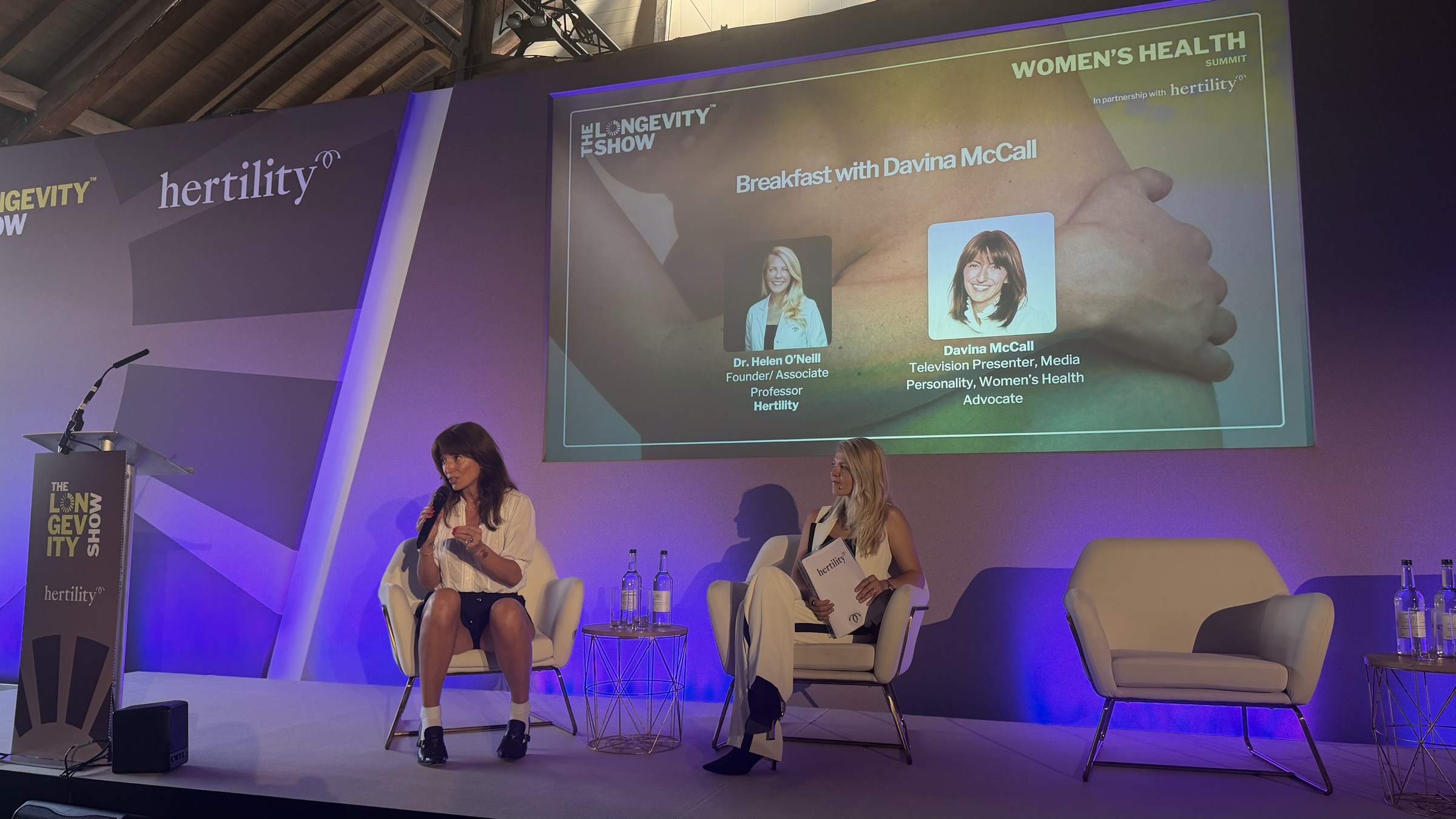

There is a cruelty built into perimenopause that the whole morning kept circling back to: the very symptoms that most need you to advocate for yourself are the ones that strip you of the confidence to do it. "I can fight for anyone else," Davina McCall said. "I'm brilliant at fighting for other people. I just couldn't fight for myself." This final part of The Quiet Storm is about how to back your own body when the storm is doing its best to make sure you can't.
Four parts in, we have covered the blind spot, the baseline, the study that scared a generation, and the hormone with no formula. This one is the rallying cry, the practical, human business of getting seen, getting heard, and getting the care you are owed. It is also, I will admit, the part I have been most looking forward to writing, for reasons that will become clear near the end.
Take a Rottweiler
McCall's single most practical piece of advice was disarmingly simple: don't go alone. Take someone with you, the friend or partner she affectionately called your "Rottweiler," the person who loves you enough to be a bit bossy on your behalf and won't let a shrug from across the desk end the appointment. When you cannot advocate for yourself, you borrow someone who can.
The second piece was quieter and just as important: write it all down. Track the symptoms, the dates, the questions, the things you meant to say and forgot the moment you sat down. Bring the list. Read from it. And be definitive, not apologetic. "You deserve to get what you came for," was the spirit of it. Perimenopause has a way of making women shrink their own requests into hedged little half-asks; the counter-move is to arrive with a written case and a witness.
Take a Rottweiler with you. Someone who loves you and will fight when you can't. Write everything down, bring the list, and don't leave until you've been heard.
O'Neill added a detail that has stayed with me since. The online health assessment her company runs sees its heaviest traffic, she said, between ten at night and one in the morning, the hours when women are finally alone with their fears, no one left to care for, at last a moment to type the questions they cannot say out loud. It is a small, sad, precise portrait of who carries this and when. The point of the tool, she said, is to turn that midnight worry into something you can walk into a clinic holding: information, ordered, ready to be acted on.
The Symptoms Nobody Names
Some of what falls away in perimenopause is rarely said aloud, and the silence costs women dearly. As estrogen declines, the tissues of the vulva, vagina and bladder change, dryness, discomfort, pain during sex, and a sharply raised vulnerability to urinary tract infections that can recur again and again. It is common, it is treatable, and it is chronically under-discussed because it sits behind a wall of embarrassment.
Both speakers were emphatic that this is one of the most transformable problems in the whole picture. Local vaginal estrogen, a low-dose treatment applied directly to the tissue, prescribed and supervised by a clinician, was described as close to a game-changer for these symptoms, and, crucially, as something that can be considered at any age and with or without systemic HRT, because it works locally with minimal absorption into the rest of the body. Recurrent UTIs in particular, they noted, are too often treated as an endless parade of antibiotics when the underlying tissue change is what needs addressing. None of that is a prompt to self-prescribe; it is a prompt to raise it, out loud, on the list, to a clinician who can help.
The People in the Room
Near the end, a man in the audience, his name was James, asked the question I suspect a lot of us in that minority were thinking: what can we actually do? McCall's answer was the best three words on the subject I have heard. Not a fix, not a speech. Just: "What do you need?" Ask it, and then listen, and don't assume you already know. She told the story of a man who, overwhelmed, had thrown a book down and walked out on a conversation about all this, and how what his partner needed was not his solutions but his steadiness, and the message underneath it: she hasn't stopped loving you; she's lost herself, and she's trying to find her way back.
She was scathing, rightly, about the cultural script that turns a struggling woman into a punchline, the "ball and chain," the "nag," the eye-roll about her moods. That script keeps men from talking to other men about any of this, and keeps women from asking for help in the one place they should be safest. The antidote is embarrassingly simple and genuinely hard: men in the room, paying attention, asking what's needed, and carrying some of the weight of learning so it doesn't all fall on the woman who is already exhausted.
The most useful thing a man can say is not a solution. It's four words: what do you need? Then listen. She hasn't stopped loving you; she's just trying to find her way back to herself.
Here is the reason I have wanted to write this part since the morning it happened. In Part 1, I mentioned that I was one of a tiny handful of men in a room of several hundred women, the only man near the front, and that before it began McCall clocked me, came over, and thanked me for being there with a long hug. At the time it felt like a small kindness. Sitting with the whole conversation now, I understand it was the thesis. The movement these two women are building is not a fortress with the drawbridge up; it is a room with the doors open, and the people who stand beside women (partners, sons, colleagues, doctors, the odd founder taking notes) are meant to be inside it. Being in the room is the smallest possible thing a man can do. It is also, apparently, worth a hug. So: consider this five-part series my answer to James's question. This is what I could do.
This article is educational and reports views and personal experiences shared by Davina McCall and Dr Helen O'Neill at a public event, alongside independently sourced science; it is not medical advice. Vaginal (local) estrogen is a prescription-only medicine and, like all the treatments discussed in this series, should be considered only with a qualified clinician who knows your history, its use with any history of hormone-sensitive cancer is an individual specialist decision. Recurrent urinary infections and any new or persistent symptoms should be assessed medically. If you are struggling with your mental health, please speak to your GP or, in the UK, contact the Samaritans on 116 123. BODY HLTH supplements are not medicines and do not treat, cure or prevent disease.
The storm is quiet.
Your response doesn't have to be.
You have more control than the fog lets you feel. Know your baseline and test while you're well. Read the study, not the scare. Ask about the hormone nobody plots and the symptoms nobody names. Take a fierce advocate, write it all down, and refuse to leave unheard, and let the people who love you stand in the room and carry some of it. The quiet storm is a transition, not a verdict. How you move through it is yours to decide.
Back your body. It has been backing you this whole time.
- 01The Menopause Society (formerly the North American Menopause Society). Position statement on the genitourinary syndrome of menopause and the use of vaginal estrogen. On local estrogen efficacy, minimal systemic absorption, and use at any age.
- 02National Institute for Health and Care Excellence. Menopause: identification and management (NG23). 2015, updated 2024. On vaginal estrogen for urogenital symptoms.
- 03Systematic reviews of vaginal estrogen for the prevention of recurrent urinary tract infections in postmenopausal women.
- 04The peak-hours figure for online health assessments (10pm-1am) was presented by Dr Helen O'Neill at the event and is reported here as her account.
- 05Quotations and the audience exchange are drawn from the conversation between Davina McCall and Dr Helen O'Neill at The Longevity Show, Tobacco Dock, London, June 2026, and reflect views the speakers expressed there; clinical mechanisms are sourced independently to the literature above.
- 06If you are affected by any of the issues in this series, speak to your GP. In the UK, the Samaritans can be reached free on 116 123, at any hour.