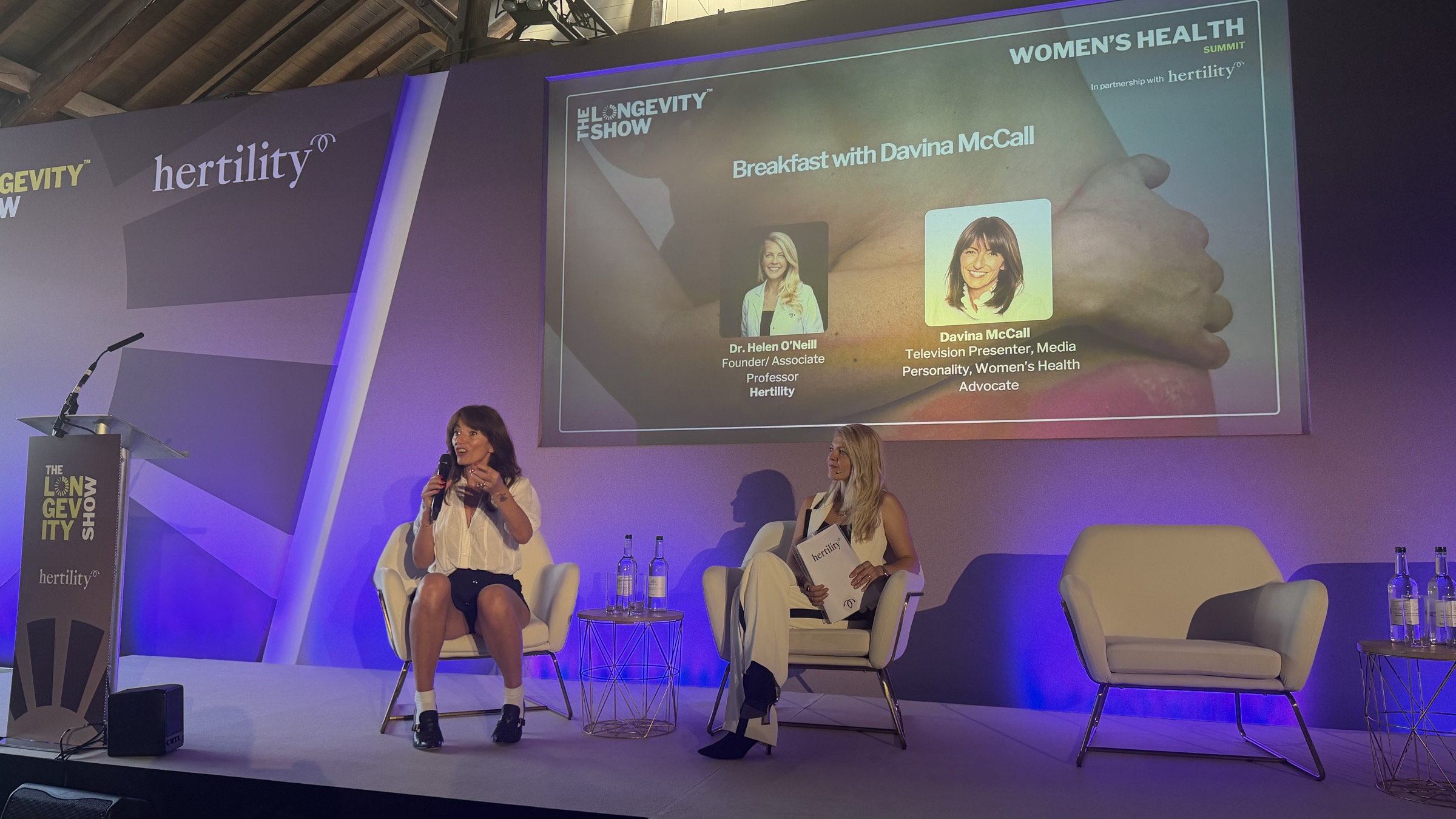

There is a single year that hangs over every conversation about menopause, and Dr Helen O'Neill named it without hesitation. "It comes back to one study, conducted in 2002," she said, "done incorrectly, on a completely different type of HRT, in a completely different population of women." That study reshaped how a generation of women, and the doctors treating them, thought about hormone therapy. Most of the fear it created has outlived the evidence that started it.
This is Part 3 of The Quiet Storm. It is also the part where I have to be most careful, because we are now in the territory of a prescription-only medicine, of individual cancer histories, and of decisions that belong between a woman and her doctors and nobody else. So let me be clear at the outset: nothing here is medical advice, none of it is a recommendation to start or stop anything, and every clinical claim is either something a speaker said at the event, reported as such, or independently sourced to the literature. With that said, the story of how one study frightened millions of women is worth telling straight.
The Ghost of 2002
The trial in question was the Women's Health Initiative, and when its combined-hormone arm was halted early in 2002, the headlines were seismic: HRT raises breast-cancer risk. What the headlines carried far less often were the caveats that reframe almost everything. The women studied were, on average, well past menopause, many in their sixties, a decade or more from their last period. The hormones used were an older oral formulation: conjugated equine estrogen taken as a pill, with a synthetic progestogen. And the absolute increase in risk, when you read past the relative figures, was small.
It was one study, done incorrectly, on a completely different type of HRT, in a completely different population of women. And it frightened a whole generation away from something that could have helped them.
O'Neill's wider point was about proportion. The everyday things we barely think about, carrying extra weight, drinking regularly, smoking, move breast-cancer risk too, and for many women move it by more than modern HRT does. That is not a licence to be cavalier; it is a plea to weigh the risk honestly, in context, rather than treat one word, cancer, as the end of the conversation. The tragedy of 2002 was not that it raised a real question. It was that the question was heard as a verdict.
What HRT Actually Is Now
The treatment that frightened people in 2002 is, in large part, not the treatment on offer today. The modern standard, available on the NHS, is body-identical HRT: estrogen with a molecular structure identical to what the body makes, delivered transdermally, through the skin, as a gel or patch rather than a pill. That route matters. Taken through the skin, estrogen bypasses the first pass through the liver, which is associated with a lower clotting risk than the older oral forms. It is, as O'Neill put it, a different medicine for a different era.
Davina McCall's own account tracked exactly this arc, from fear to information to relief. When her gynaecologist first raised HRT, her instinct was dread: isn't that the thing that causes breast cancer? "That's the old HRT," she was told, "the non-bio-identical stuff." She started low, built up slowly, and described the result in three words that got a laugh and a round of applause: "I'm back." Not fixed, not cured, back. Herself again.
I was terrified. I thought HRT was the thing that gave you cancer. And they explained: that's the old stuff. This is body-identical, through the skin. I started low, built up, and honestly, I'm back.
Both women stressed a second point that rarely makes the headlines: timing. The benefits of hormone therapy appear to be greatest when it is started early, around the onset of menopause rather than years later. Wait too long, and the window in which some of the protective effects are thought to operate may have narrowed. It is the mirror image of Part 2's message about baselines: in perimenopause, when you act is not a footnote to whether you act. It is part of the decision.
The Harm Nobody Counted
What makes 2002 more than a historical footnote is what came after it. As O'Neill described it, HRT prescribing collapsed in the years that followed, women came off it, and a generation of younger women never started. What rose instead, she said, was the prescribing of antidepressants to women of exactly this age, and (she did not soften it) reported rates of self-harm and suicide in midlife women that she called alarming. She was clear this was what she was presenting from her vantage point, not a settled causal chain. But the shape of it is hard to unsee: a treatment for the biology was withdrawn, and treatments for the symptoms rushed in to fill the gap.
I am reporting that last figure as what she said, because the causal story is genuinely contested and the numbers are hard to pin down, antidepressant use rose for many reasons over those years, not one. But the underlying question deserves to stand: if a biological transition can produce anxiety, rage and despair severe enough to be mistaken for a primary psychiatric illness, then withdrawing the biological treatment and reaching only for psychiatric ones was, at the very least, an incomplete answer.
A Story That Isn't a Template
And then McCall told the room something braver than most people would say into a microphone. She has since been treated for breast cancer, an estrogen-receptive tumour, found early because she has dense breast tissue and pushed for the additional imaging (a mammogram plus ultrasound) that dense breasts warrant. It was treated with surgery and radiotherapy. And afterwards, she and her oncologist and her menopause specialist made a decision together that surprises people: she stayed on HRT.
She was scrupulous about why, and about the fact that it was her decision, for her body. She also lives with cardiovascular disease, and estrogen supports the blood vessels; for her, weighed against her particular cancer, her particular heart, and her particular risk tolerance, staying on treatment was the balance she and her doctors struck. She monitors it closely. She was emphatic that an estrogen-receptive cancer changes the calculus, that vigilance is non-negotiable, and, most important of all, that none of it generalises.
Everybody is different. My journey is going to be different from yours. This was my decision, with my doctors, for my body, please don't take it as advice for yours.
I have thought a lot about why she chose to share something so private. I think it is because the alternative, leaving the impression that a cancer diagnosis is a simple, universal "stop", is its own kind of misinformation, and she has spent years fighting exactly that. Her story is not a permission slip. It is a demonstration that these decisions are genuinely individual, genuinely medical, and genuinely hers to make with the people qualified to make them.
HRT is a prescription-only medicine. This article reports views and personal experiences shared by Davina McCall and Dr Helen O'Neill at a public event, alongside independently sourced science; it is not medical advice and not a recommendation to start, stop or change any treatment. Decisions about HRT, and they are especially individual for anyone with a personal or family history of breast cancer, blood clots or cardiovascular disease, must be made with qualified clinicians who know your full history. Davina McCall's decision to continue HRT after an estrogen-receptive breast cancer was hers, made with her oncologist and menopause specialist, and does not generalise to anyone else. BODY HLTH does not provide HRT; our role here is editorial.
The fear was real.
It was also mostly the wrong fear.
One trial, run in 2002 on an older oral hormone in women a decade past menopause, was heard as a verdict on a treatment most of those women were never taking. The modern standard, body-identical estrogen through the skin, started early, monitored properly, is a different medicine, and the honest conversation is about weighing real risks in context, not surrendering to a single frightening word.
Read the study, not just the headline it spawned, and have the conversation with someone qualified to have it with you. Next in the series: the hormone women lose too, the one with no licensed formula of its own.
- 01Rossouw JE, Anderson GL, Prentice RL, et al. Risks and benefits of estrogen plus progestin in healthy postmenopausal women (Women's Health Initiative). JAMA. 2002;288(3):321-333.
- 02Manson JE, Chlebowski RT, Stefanick ML, et al. Menopausal hormone therapy and health outcomes during the intervention and extended poststopping phases of the WHI trials. JAMA. 2013;310(13):1353-1368.
- 03Manson JE, Aragaki AK, Rossouw JE, et al. Menopausal hormone therapy and long-term all-cause and cause-specific mortality: WHI randomized trials. JAMA. 2017;318(10):927-938. On age-stratified benefit-risk and the timing hypothesis.
- 04National Institute for Health and Care Excellence. Menopause: identification and management (NG23). 2015, updated 2024. On transdermal versus oral HRT and venous-thromboembolism risk.
- 05The characterisation of the post-2002 fall in HRT prescribing, and the reported rise in midlife women's antidepressant use, self-harm and suicide, were presented by Dr Helen O'Neill at the event and are reported here as her account; the causal relationships are contested and not established here as fact.
- 06Davina McCall's account of her breast-cancer diagnosis, treatment and decision to continue HRT was shared by her at The Longevity Show, Tobacco Dock, London, June 2026, and is reported as her personal experience. It is not clinical guidance and does not generalise.