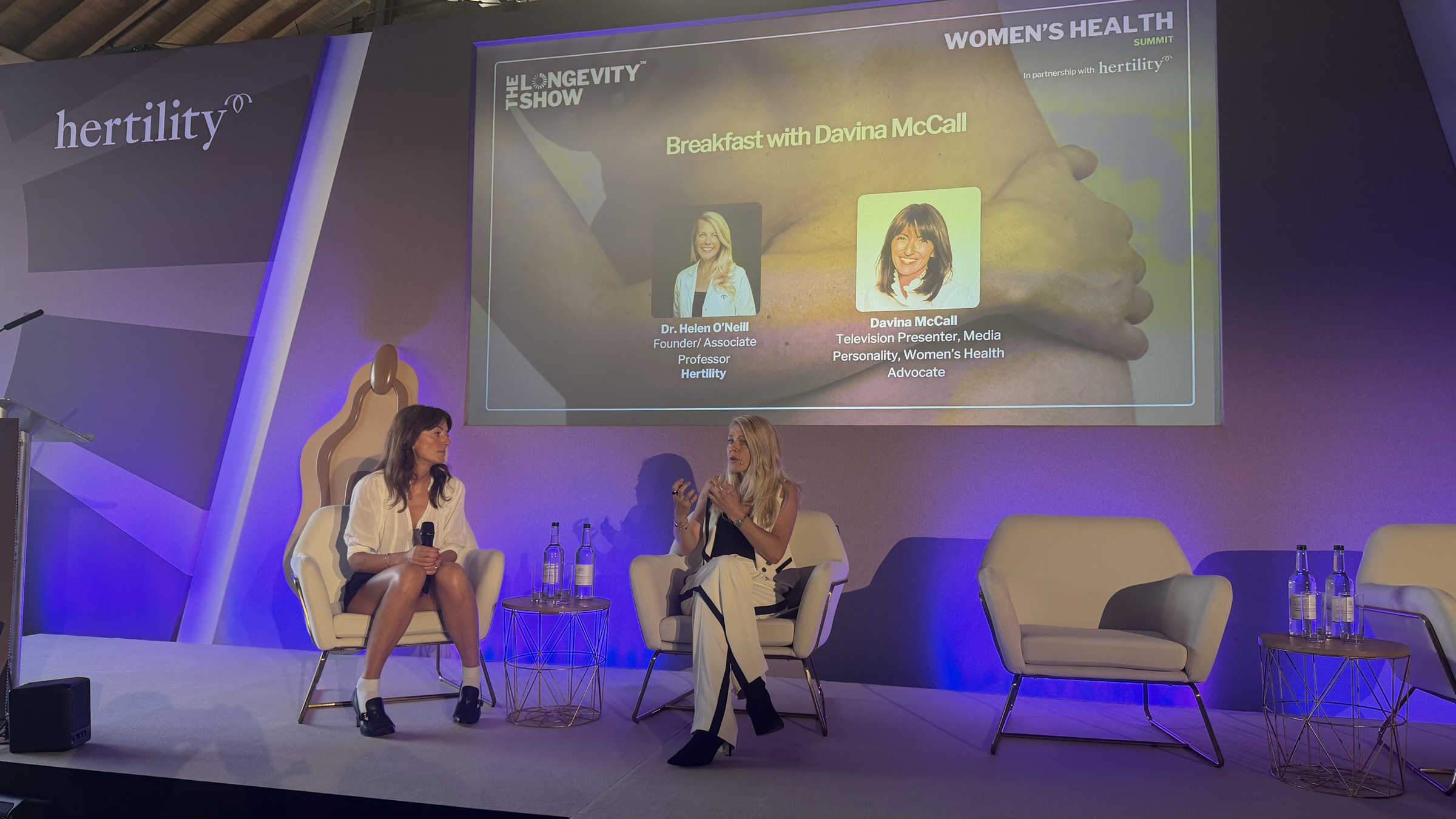

Here is the sentence that reorganised how I think about testing. "When you actually feel good," Dr Helen O'Neill told the room, "when you feel healthy, when you feel strong, check what your levels are." Not when it all falls apart. Not when you are already frightened of driving to the supermarket. While you are still, unmistakably, yourself. It sounds backwards. It is, in fact, the whole game.
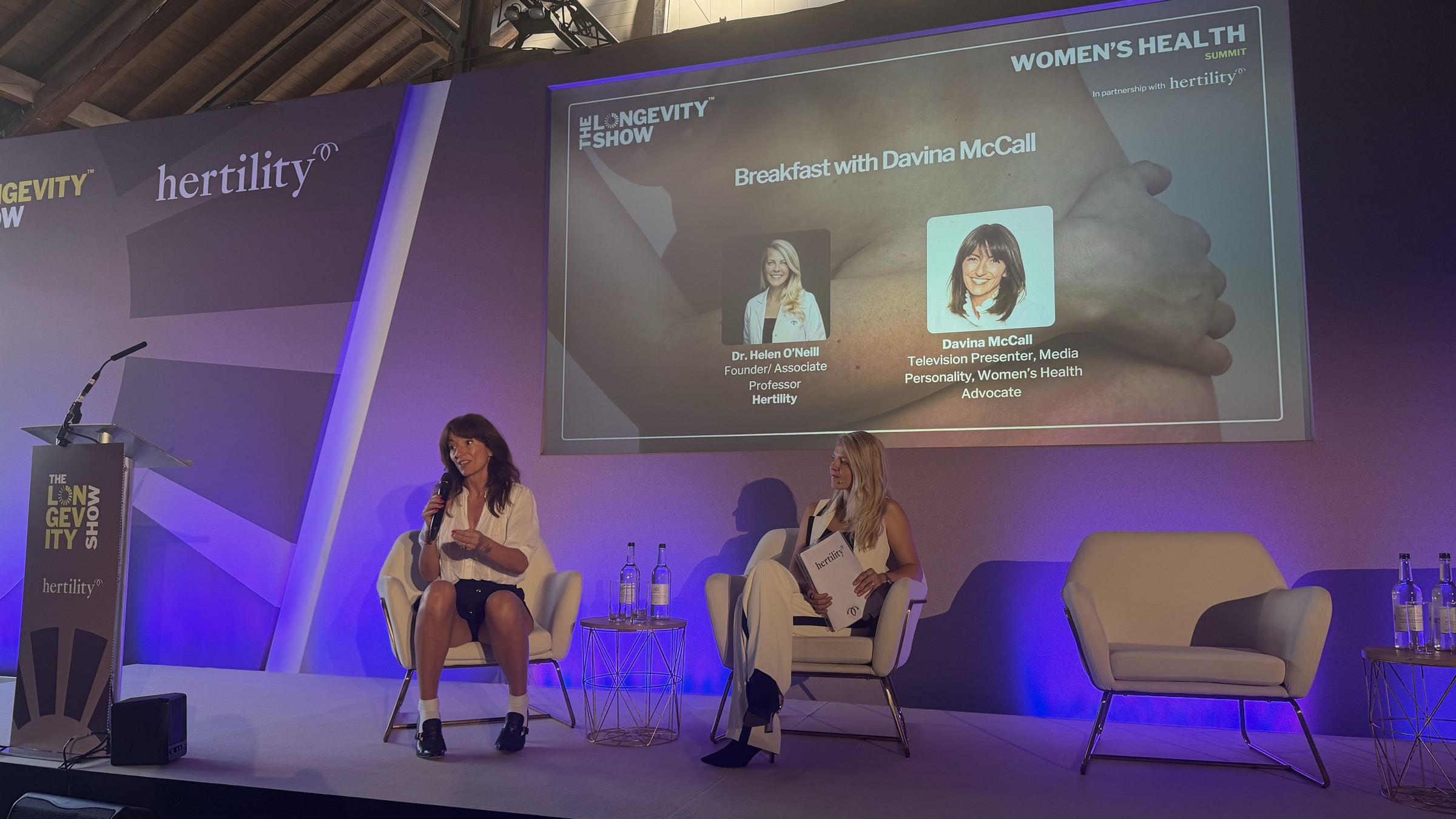
This is Part 2 of The Quiet Storm, our series built from Davina McCall and Helen O'Neill's conversation at The Longevity Show in London. Part 1 was about the symptom medicine keeps missing, "I don't feel myself." This one is about the practical problem that follows: once you suspect something is shifting, what do you actually measure, and when? The answer the two of them arrived at, from very different directions, upends the usual advice to "get your hormones tested" the moment you feel off.
Why One Test Lies
Start with what a blood test can and cannot do in perimenopause. McCall was blunt about it: a single reading will not tell you whether you are perimenopausal, "because one day your hormones are good, and the next day your hormones aren't, and the next day they're good again." Test on a good day and the numbers look reassuringly normal; test on a bad one and they don't, and neither snapshot describes the moving target underneath.
You'd go, your hormones are fine, and I'd go, yes, but yesterday I was a wreck. Once you're in perimenopause, your hormones are just all over the place. The readings won't help you much.
This is why, in the UK, perimenopause is diagnosed on symptoms rather than bloods for most women over 45, the guidance recognises that a fluctuating hormone tells you little on any given day. O'Neill's frustration ran deeper still: the reference ranges themselves are so wide that "we all fit within the normal criteria, unless things are really, really bad." In other words, you can feel dreadful and still test "normal," because normal is defined across the entire population, not against the you of two years ago.
The Baseline You Never Took
That is the argument for testing while you are well. If the reference range is a vast field that almost everyone fits inside, then the only meaningful comparison is you against yourself, your endogenous baseline, measured when you feel normal. "You very quickly realise when you don't feel normal," O'Neill said, "and when you don't feel like yourself anymore." But without a reading from the good years, you have nothing to hold the bad ones against.
When you feel good, when you feel healthy, when you feel strong, check what your levels are. Because the reference ranges are so wide that we all fit within the normal criteria, unless things are really, really bad.
She made a related point that lands harder the longer you sit with it. Most of us were handed hormonal contraception as teenagers without anyone ever measuring the hormones it was replacing. "Would it have been appropriate, prior to being put on hormonal contraception, to check what your hormones are?" she asked. We don't look at the blood, not then, and often not for decades after. A whole reproductive life can pass without a single baseline reading of the system that governs so much of how you feel.
The Two That Do Hold Still
There is an important exception to the "readings won't help you" rule, and both women were careful to name it. While estrogen and progesterone swing day to day, two things move more slowly and are worth measuring on their own terms: the thyroid, and, separately, testosterone, which gets its own instalment later in this series.
The thyroid is not a bit-part player. "It is literally the master conductor of your entire endocrine orchestra," O'Neill said, and its failures are staggeringly common. The single most-prescribed drug in the world, she noted, is thyroxine, the replacement hormone for an underactive thyroid. This is a global problem hiding in plain sight, and its symptoms, fatigue, low mood, brain fog, weight change, are exactly the ones women are told to expect from perimenopause, or from life.
McCall's own experience made the case for repeat testing, not one-off testing. Now that she is settled on treatment, she takes a blood test every six months, and it was one of those routine checks that caught her thyroxine running too high, prompting a drop from a dose she had been on for years. "I'm constantly trying to reach homeostasis," she said. The body is not a problem you solve once; it is a level you keep. You cannot keep a level you never measured.
The Deficiency Hiding in Plain Sight
The other number both women wanted women to check was iron, and here O'Neill made a point of history. Women today menstruate more than any generation before them. For most of human history women spent large stretches of life pregnant or breastfeeding, not bleeding; now, unless on hormonal contraception, we bleed every month for decades. "The number one thing you're losing is your iron," she said, "and we are really poor at holding on to it." Her estimate: 30 to 40% of the women in that room were iron deficient, with a systemic impact, fatigue, breathlessness, hair loss, low mood, that mimics half the menopause symptom list.
Don't just check your haemoglobin levels. Check your ferritin.
That distinction matters clinically. A standard full blood count can report a normal haemoglobin while your iron stores, measured by ferritin, are quietly running down, so you can be told your blood is "fine" while you are, in fact, depleted. It is the same pattern as the hormones: the routine test answers a different question from the one you are asking.
This is also, candidly, the thinking behind how we approach testing at BODY HLTH: less a single dramatic verdict, more a picture built while you are well and revisited over time, hormones read in the context of thyroid, iron and the wider bloodwork, so you have a baseline to defend rather than a snapshot to argue with. O'Neill put the principle better than any brand ever could: your blood results "weave a very rich tapestry into who we are." No one thread tells the story.
This article is educational and reports views expressed by Davina McCall and Dr Helen O'Neill at a public event; it is not medical advice. Blood tests should be requested and interpreted with a qualified clinician, who can decide which tests are appropriate for you and what the results mean in context. Do not start iron or any other supplement on the basis of self-testing alone; iron in particular can be harmful in excess. Always consult a clinician before acting on any result. BODY HLTH supplements are not medicines and do not treat, cure or prevent disease.
Don't test to find the crisis.
Test to remember the calm.
The instinct is to reach for a blood test the moment something feels wrong. But in perimenopause a single reading is a photograph of a moving target, and the reference range is so wide you can feel awful and still measure "normal." The move both women urged is the opposite of the instinct: establish your baseline while you feel well, then track it, and pay separate attention to the thyroid and iron, which actually hold still enough to read.
Know the level you feel like yourself at, so you can prove it when you don't. Next in the series: the single study, run badly in 2002, that frightened a generation of women away from the treatment that might have helped them.
- 01National Institute for Health and Care Excellence. Menopause: identification and management (NG23). 2015, updated 2024. Diagnosis in women over 45 on the basis of symptoms rather than blood tests.
- 02Santoro N, Randolph JF. Reproductive hormones and the menopause transition. Obstetrics and Gynecology Clinics of North America. 2011;38(3):455-466. On cycle-to-cycle variability of FSH and estradiol.
- 03World Health Organization. Global report on the prevalence of anaemia and iron deficiency in women of reproductive age. On the scale of iron deficiency and the ferritin-versus-haemoglobin distinction.
- 04Taylor PN, Albrecht D, Scholz A, et al. Global epidemiology of hyperthyroidism and hypothyroidism. Nature Reviews Endocrinology. 2018;14(5):301-316. On the global burden of thyroid disease and thyroid-hormone prescribing.
- 05Iron-deficiency and thyroxine-prescribing figures were cited by Dr Helen O'Neill at the event and are reported here as stated; they are consistent with the published sources above.
- 06Quotations are drawn from the conversation between Davina McCall and Dr Helen O'Neill at The Longevity Show, Tobacco Dock, London, June 2026. Attributions reflect views the speakers expressed at that event; clinical mechanisms are sourced independently to the literature above.