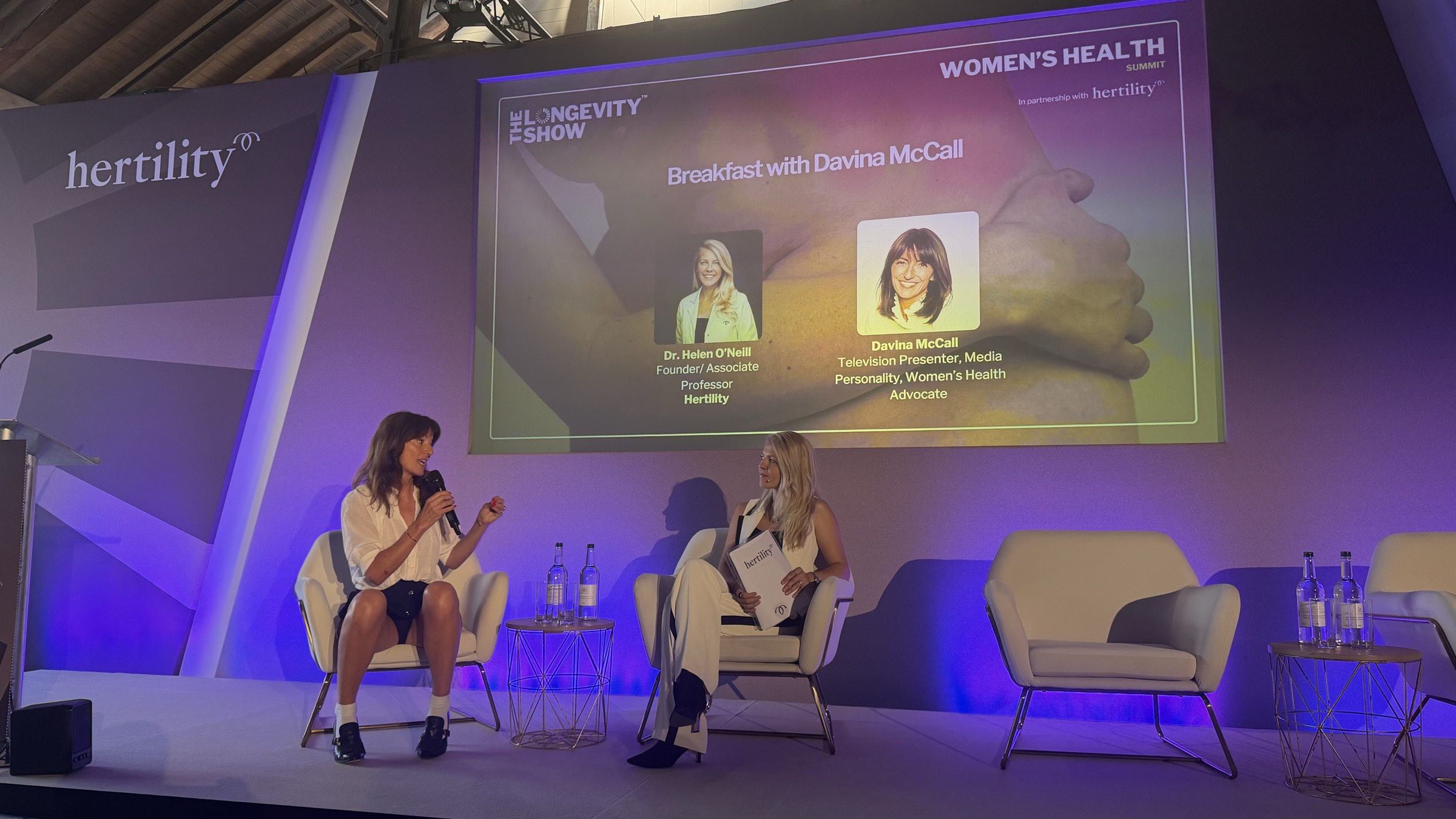

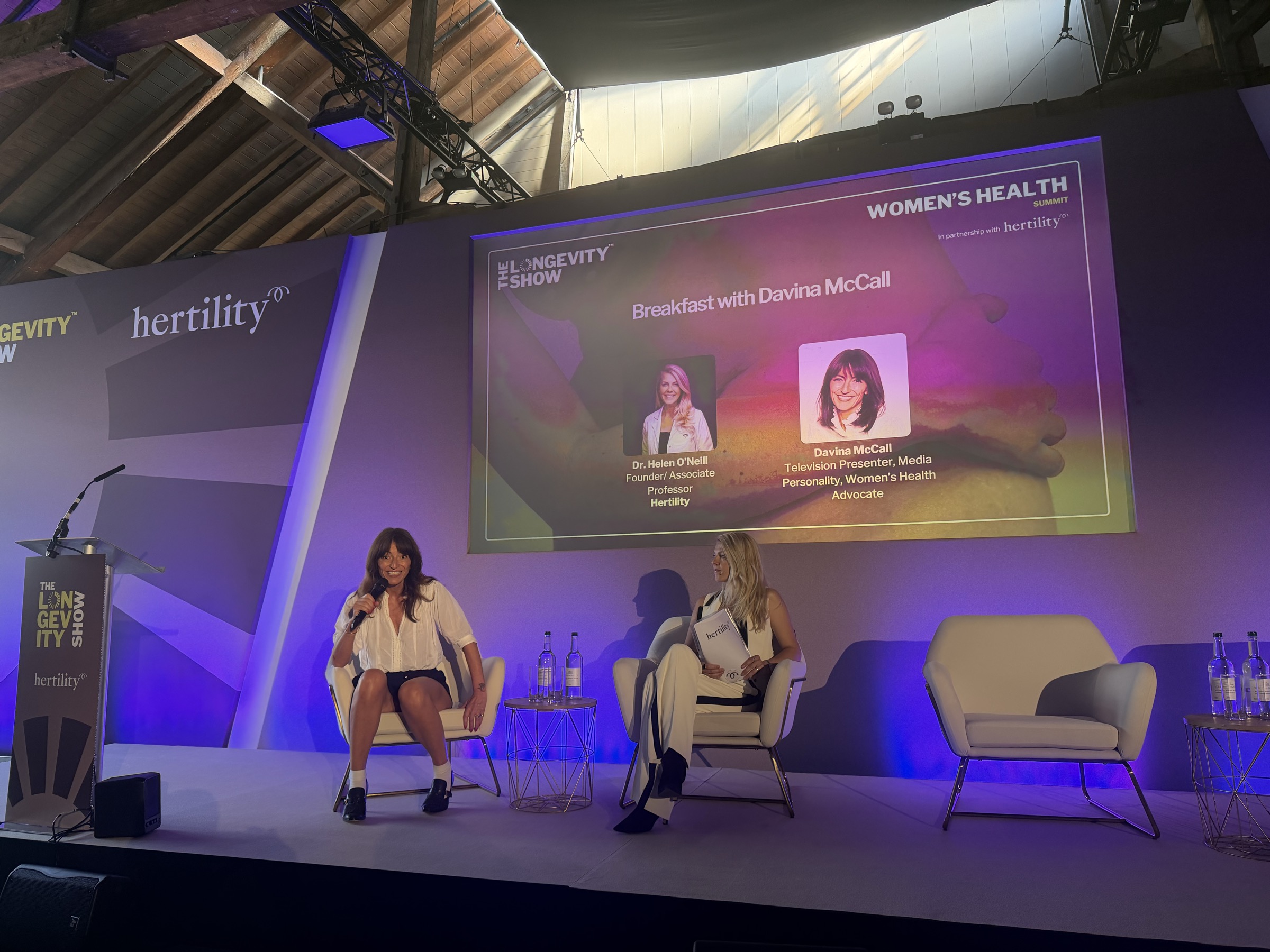
It was billed, with a wink, as a breakfast with no breakfast, a morning conversation at a longevity conference where the coffee was strong and the food was theoretical. Davina McCall walked on to the kind of warmth usually reserved for someone the whole room grew up watching. But the subject she and Dr Helen O'Neill circled for the next hour was not warm at all. It was the sentence thousands of women take to their doctor and get sent home with: I don't feel myself.
McCall needs little introduction, three decades on British television, and, more recently, one of the most effective menopause campaigners the country has. Beside her sat Dr Helen O'Neill, a reproductive geneticist and the founder of Hertility, a women's-health company that has run detailed hormone-and-symptom assessments for more than a million women. One spoke from lived experience; the other from a database. What was striking was how completely the two accounts agreed. This is the first of a five-part series, The Quiet Storm, built from that single conversation, and it starts where perimenopause actually starts for most women: not in the body, but in the mind.
A word about where I was sitting. I was one of a very small handful of men in a room of several hundred women, and the only man near the front. I mention it only because of what happened next. Before the conversation began, McCall clocked me, came over, and thanked me for being there with a long hug. It was over in a few seconds, and it told me something I kept thinking about all morning: the movement these two women are building is not a fortress. The whole point of it is that the rest of us, the partners and sons and colleagues and doctors, are meant to be in the room. That is why I am writing this at all, and why the series ends, five parts from now, on exactly that question: what the people around a woman can actually do.
The Symptom That Isn't a Symptom
McCall was 43 when it began, though she did not have a word for it. "I didn't even know perimenopause was a thing," she said. "It just hadn't crossed my mind." What she noticed was not a hot flush. It was that she had, somehow, gone missing from her own life. "The best way I can describe it is: I don't feel myself. There's something wrong. Like I've lost something."
The specifics were almost too ordinary to report to a doctor, which is exactly the problem. A woman who had thrown herself out of a helicopter over the Grand Canyon on live television found she had become frightened of driving to the supermarket at dusk. Rage arrived from nowhere and went nought to sixty. She would get her three children ready for school, then sit in the car with her head on the steering wheel and cry. And then, presenting a live show, she looked at a household-name guest she had known for years, Laurence Llewelyn-Bowen, and could not retrieve his name.
The first symptoms you notice are not always the physical ones; they're often the emotional ones. These aren't sweats or aches or palpitations. These are mental. And they were very real.
The word she kept returning to was shame, an emotion she said had been unfamiliar to her before, and which now sat on everything. "I thought, I'm not sure I can present television anymore." She went to a doctor and offered the only description she had. I don't feel myself. The reply, more or less: you'll be fine, you're just overwhelmed. It took a gynaecologist, eventually, to say the word she had never heard, perimenopausal, and to explain that what looked like a personality dissolving was, in large part, chemistry.
"You're Too Young", and Other Dismissals
Part of why the sentence gets missed is that women are, routinely, told it cannot be what it is. For years, McCall noted, a woman presenting under 45 would be waved away as too young, the assumption being that perimenopause simply does not start before then. It is a dangerous half-truth. Formal guidance does lean on age, but perimenopause can begin in the late thirties, and the symptoms that herald it are precisely the ones least likely to be attributed to hormones: anxiety, low mood, brain fog, a fuse that has mysteriously shortened.
O'Neill's objection was structural. Medicine, she argued, wants women to satisfy a formula before it will listen, a tidy count of qualifying symptoms, the right numbers on the right hormones, when the lived reality does not arrive in that order or that shape. "We expect women to tick a box," she said. And the box, too often, is drawn to exclude them.
What's so nebulous about not feeling yourself is that you can't really quantify it. Someone says, where's the barometer? So we went and put a number on it.
That is Hertility's whole proposition, and O'Neill's answer to being dismissed: turn the collective, unheard experience of women into something a clinician cannot argue with. When the company asked women how they were feeling, calm, neutral, stressed, or completely overwhelmed, more than 60% chose stressed or completely overwhelmed. The women who arrived saying they were "just curious," rather than symptomatic, turned out on average to be carrying a substantial symptom load they had simply stopped noticing. By the time many women describe themselves as having symptoms at all, they are well past the point where help would have been reasonable to ask for.
A Quiet Storm, Not a Switch
The most useful reframing of the morning was about shape. We talk about menopause as an event, a switch that flips, a door that closes, and then wait for a dramatic moment that never quite comes. O'Neill's point was that this is the wrong mental model entirely. "It is not like something is switched off," she said. "It is a steady, slow decline." Perimenopause is the years of turbulence before that, hormones not gone, but swinging: high one day, low the next, and rarely where they were.
McCall's word for it was a quiet storm, and it captures why the emotional symptoms are so disorienting. There is no single collapse to point at, no clean before-and-after. Instead there is a slow, deniable erosion, and a woman quietly compensating for it, setting the alarm half an hour earlier, working twice as hard to feel half as capable, until she can no longer tell whether what she feels is hormonal or simply the accumulated weight of a demanding life. "Is this my hormones," as McCall put it, "or is this just life?"
That ambiguity is not a reason to dismiss the symptoms. It is the reason to take them seriously. Both women were clear that stress, ageing and hormonal change are not competing explanations to choose between; they compound. And the British reflex, McCall observed, is to wait it out: "I am waiting until I feel absolutely horrific, and then I will consider doing something about it." O'Neill's rejoinder was sharper. We warn people not to burn out, she said, but nobody can tell you, in advance, what ash feels like. You are expecting a big, unmistakable moment. It does not come. You simply adjust, and adjust, and adjust.
The Shift Already Underway
There was, amid the frustration, real optimism, because the clinical culture is beginning to move. McCall described recent work with the Royal College of Psychiatrists, which she said has advised that when a woman presents in midlife with low mood, clinicians should not reach automatically for an antidepressant. Instead, they should consider whether low or fluctuating hormones are part of the picture, and where appropriate refer her to a specialist to discuss the options, including hormone replacement therapy if that is a path she wants to take.
For anyone who has watched a midlife woman handed an SSRI for what was, in part, a hormonal problem, this is a meaningful correction, an acknowledgement, McCall said, that in 2026 "women are finally being seen." It does not mean antidepressants are wrong; for many women they are exactly right. It means the question is finally being asked before the prescription is written, rather than after years of feeling unheard.
O'Neill's contribution to that shift is quieter and, in its way, just as radical: giving a woman something to hold. When Hertility looked at the women who ticked the box marked "no formal diagnosis, but I suspect something is up," the overwhelming majority turned out to be right. "You are the expert of your own body," she told the room, and the job of the data is not to replace that instinct but to arm it, so that a woman walking into a nine-minute appointment is not asking to be believed. She is presenting evidence.
This article is educational and reports personal experience and views expressed by Davina McCall and Dr Helen O'Neill at a public event; it is not medical advice and not a recommendation to start, stop or change any treatment. Low mood, anxiety and cognitive changes have many possible causes and can overlap with perimenopause, if you are experiencing them, please speak to a qualified clinician who can assess your individual situation. Hormone replacement therapy is a prescription-only medicine and appropriate for some women and not others; any decision about it belongs with you and your doctor. BODY HLTH supplements are not medicines and do not treat, cure or prevent disease.
The first sign isn't a hot flush.
It's the feeling you've gone missing.
What McCall and O'Neill described, from opposite ends, one woman's story and a million women's data, is the same blind spot. Perimenopause announces itself in anxiety, rage, brain fog and an unfamiliar shame long before it announces itself in the body, and those are precisely the symptoms most likely to be filed under "just stress" and sent home.
"I don't feel myself" is not vague. It is a symptom. Naming it, and being taken seriously when you do, is where everything else begins. Next in the series: why a single blood test can miss all of this, and the counter-intuitive advice both women kept returning to, get tested while you still feel well.
- 01Bromberger JT, Kravitz HM. Mood and menopause: findings from the Study of Women's Health Across the Nation (SWAN). Obstetrics and Gynecology Clinics of North America. 2011;38(3):609-625.
- 02Maki PM, Kornstein SG, Joffe H, et al. Guidelines for the evaluation and treatment of perimenopausal depression: summary and recommendations. Journal of Women's Health / Menopause. 2019;28(2):117-134.
- 03National Institute for Health and Care Excellence. Menopause: identification and management (NG23). 2015, updated 2024. Note on diagnosis by symptoms and on perimenopause presenting before age 45.
- 04Royal College of Psychiatrists, position on menopause and mental health, as described by Davina McCall at the event: consider hormonal factors in midlife low mood rather than defaulting to antidepressants, and refer for specialist assessment where appropriate.
- 05Hertility Health women's-health assessment figures (proportion reporting stress/overwhelm; dataset scale), cited by Dr Helen O'Neill at the event and reported here as stated.
- 06Quotations are drawn from the conversation between Davina McCall and Dr Helen O'Neill at The Longevity Show, Tobacco Dock, London, June 2026. Attributions reflect views the speakers expressed at that event; clinical mechanisms are sourced independently to the literature above.